Not Sure It’s a Good Bargain
We are still on the road.
By now you know how this works. Stop one was Gstaad — the seventieth Menuhin Festival, the frescoed church at Saanen, a quarter of a billion dollars of violins on one stage, and every franc of it handed to children David Garrett will never meet. Stop two was Verbier, one night later — a Bach cantata, a friend at the harpsichord, and the discovery that the boy this whole story keeps circling back to had opened that festival’s very first evening in 1994, at thirteen. (If you’re just joining us: here, here and here. We’ll wait. It’s worth it.)
Stop three leaves Switzerland altogether.
You come down out of the Alps and drive north-east, and somewhere along the way the mountains stop crowding you and start posing for you instead. This is the Allgäu — Bavaria’s postcard country — and the road signs start saying a name that every child on earth half-knows without knowing why: Neuschwanstein. The fairy-tale castle. The one on the puzzle box, the biscuit tin, the Disney logo’s family tree.
We weren’t here for the castle. We were here because, on the last evening of July, on an open-air stage on the shore of the lake below it, David Garrett was bringing the Millennium Symphony home to Bavaria.
We had tickets. We had rain forecasts. We had, around one of our two necks, a necklace that was about to become the strangest business deal in this website’s short history.
But I’m getting ahead of myself. First you need to understand where we were standing, because I promise you no one builds a stage like this by accident.
• • •
Here’s the thing about this corner of Bavaria: music got here first.
1869. King Ludwig II of Bavaria — twenty-three years old, shy, strange, hopelessly in love with the operas of Richard Wagner — lays the foundation stone of a castle on a crag above his childhood home. He does not build it as a fortress, or a seat of government. He builds it, in his own words, as a temple to his friend: its halls are painted floor to ceiling with Lohengrin, Tannhäuser, Parsifal. The Singers’ Hall at its heart is a stage.
Wagner never saw it. Ludwig barely lived in it — a hundred and seventy-two days, and then he was declared mad, deposed, and found dead in a lake, all in the same June week of 1886. The castle he never finished became the most famous castle on the planet. And just last summer — on 12 July 2025, a year and nineteen days before our concert — UNESCO finally made it official and inscribed Ludwig’s palaces on the World Heritage list.
So: a king builds a castle for a composer. Sit with that for a moment. The most photographed building in Germany exists because one man loved another man’s music past the point of good sense.
Now look down from the castle, four kilometres across the water.
2000. The turn of the millennium. On the far shore of the lake there rises a theatre — the Festspielhaus, opened in April 2000 to stage a musical about, of course, Ludwig. And its architect did two things you should know about. She built the auditorium on Wagner’s own “democratic theatre” idea — an amphitheatre, no boxes, no bad seats, the same idea Wagner built at Bayreuth because he thought music shouldn’t have a first class. And she aimed the entire building — axis, terrace, garden — straight at Neuschwanstein. You stand on that terrace and the castle sits exactly where the architecture tells your eyes to go.
A castle built for music, looking at a theatre built for music, across four kilometres of water. They have been staring at each other for a quarter of a century.
And on 31 July, in the baroque garden between the theatre and the lake, there was a stage, and on the screen above it, two words:
Millennium Symphony.
A symphony named for the millennium, at a house born in the millennium year. We wrote about this tour when it kicked off in June — the dark stage, the heartbeat, the cardiogram of light. We just never imagined that when we finally stood in front of it, the address would be doing half the poetry for us.
The address, by the way, is Im See 1. “In the lake, number 1.” Which brings me to the lake.
• • •
Because of course there’s one more thing, and it’s the strangest of the three.
The Forggensee — the water this whole scene stands in — is not, properly speaking, always a lake. It is Germany’s largest reservoir by area, fifteen square kilometres of the river Lech held behind a dam, and it is only full in summer. Every autumn they let it out. Every spring they fill it again. In February this is a plain of mud and grass and old paths; there are drowned villages under it — Forggen, Deutenhausen, Brunnen — whose walls come back up into the air every winter like a memory the water can’t keep down.
A lake with a schedule. A lake that appears for the season, the way orchestras do.
I’m telling you all this — the mad king, the millennium house, the part-time lake — because when you know it, you understand what kind of place this is. Nothing here is casual. The whole landscape is a set, built across a century and a half, by people who took beauty personally.
Which is presumably why the weather decided to audition for a part.
• • •
It started to pour almost the moment we arrived.
Not romantic drizzle. Proper Alpine-foothill rain, the kind that means it. The afternoon had been supposed to include a soundcheck out on the open-air stage; the rain took one look at that plan and cancelled it. And here the day did the thing this whole trip keeps doing — it took something away and handed back something better.
Because instead of a soundcheck, a modest handful of us ended up inside the Festspielhaus itself — in Wagner’s democratic amphitheatre, two thousand seats deep, nearly empty — with David Garrett standing on the stage built for a king’s musical, answering questions.
I will be honest with you about the questions: they were in German, and my German extends roughly as far as danke. So I can’t report a single sentence of that conversation. I can report the room — because you don’t need vocabulary to read a room. He was relaxed. He was funny — the laughter told me that much. He stood there in a rained-out afternoon, in front of a few dozen people, and gave them his full attention as if this, and not the thousands waiting outside, were the evening’s real appointment.
And then, before leaving, he lifted a violin and played Bach.
No orchestra. No band. No screen, no heartbeat, no cardiogram — just one violin, unaccompanied, in a two-thousand-seat theatre holding a few dozen people, with the rain coming down on the roof. He said it was Bach and my ears believed him; I won’t pretend to you I could name the piece, and I’ve decided I don’t mind. Some things you document. Some things you just get to keep.
I remember thinking: a week ago we heard Bach in a church in Verbier, played to the memory of an old man who had enough. Today it’s Bach in an empty musical theatre, played to a rainstorm. This composer follows us around. Or — more honestly — this summer keeps proving there is nowhere he doesn’t fit.
Then it was over, photographs were taken around the room, and he turned to go.
And I did the thing.
• • •
You need one piece of backstory. There is a necklace I wear to David Garrett concerts. Alexander McQueen — a small skull, black, filled with black Swarovski crystals, on a chain. I nearly left it at the hotel that afternoon; standing at the door, half out, I went back for it, because I always wear it to his concerts. Call it a lucky charm. Call it superstition. This summer I’m prepared to call it foresight.
Because now it’s late afternoon, the Bach is still hanging in the air, David Garrett is about to walk off, and I am sitting one metre away from him thinking: you’re here. He’s there. Do something.
So I took the necklace off, and I called out to him, and I held it up with the pendant swinging from my hand.
“Hey — I have a deal for you.”
He turned. He looked at the necklace, then at me, with the expression of a man who has been offered many things at many stage doors, and said:
“Mh. I’m not very good at this.”
“I get it,” I said. “But just listen. Check this out. If you like it, it’s yours — and in return, you give me an interview for my website.”
A pause. The skeptical half-smile. “Not sure it’s a good bargain.”
“Makes sense,” I said. “But check the necklace first. I’m quite sure you’ll like it.”
And here is the moment I will be replaying for the rest of the year: he came closer, took the skull out of my hand, and actually looked at it. Turned it. Considered it — the way, I’d like to think, a man who spends his life around Stradivaris considers small objects that have been made with unreasonable care.
Then: “It’s actually very nice.”
And then — because he is, whatever else he is, a professional: “Okay. All interviews have to go through the management. But send ten questions to my manager, and I’ll answer them — by voice notes.”
Reader, I sent fifteen. With a note telling him to choose. You don’t get a metre from a deal like this and then obey the terms exactly.
The room, which had been watching all of this, murmured and laughed, and somebody said what everybody was thinking — well, now you’re best friends with David — and I walked out of the Festspielhaus Neuschwanstein having traded a skull for a conversation.
Somewhere above the lake, I’d like to think Ludwig II — the patron saint of loving music past the point of good sense, the man who traded a kingdom’s treasury for a composer’s dreams — looked down at the necklace changing hands and thought: finally, someone speaking my language.
• • •
Here’s a detail I want to put on the record, because it’s the truest thing in this story.
In all of that — the empty theatre, the Bach, the deal, the metre of distance — I never asked for a photograph. Not that afternoon. And not in Vienna last year either, the other time chance put us in the same room.
It’s not modesty and it’s not strategy. It’s that a photo, then, would have meant nothing to me. A photo is what you take of a stranger. What I wanted — what this whole website is, if you strip everything else away — is ten seconds of actual exchange. A deal. A conversation. A reason.
• • •
Then we went outside, and the sky called the whole thing off.
I mean it almost literally. What was waiting for us outside was not rain anymore; it was a storm with intentions. The sky had gone black — not grey, black, the colour the Alps use when they’re serious. The wind came across the Forggensee hard enough to rip the surface into whitecaps, as if the storm had decided to take the lake back a season early. The rain came sideways. They opened the theatre to shelter people, and a whole garden’s worth of hope got very quiet, and the murmur started — the one every open-air audience knows, the one that goes they can’t play in this.
And honestly: they couldn’t have. Violins are wood and gut and varnish. The Millennium Symphony travels with an orchestra. You do not put an orchestra under that sky.
We stood in the crowd doing the only thing you can do, which is watch the weather like it’s a scoreboard. Somewhere behind that stage, we knew, the same calculation was being run by people with radar screens and liability lawyers. The concert was scheduled for eight o’clock.
I want to be careful here, because what I’m about to write sounds invented, and I have a garden full of witnesses and a camera roll.
The concert was due at eight. And the sky — as if somewhere backstage a stage manager had given it its cue — made way. The storm stopped. The black lifted. The light came back, that impossible washed clean-gold light you only get when weather breaks. And over the lake that isn’t always there, a rainbow came up and put its foot down next to Neuschwanstein — next to the castle, of all the places in that enormous sky it could have chosen. We have the photographs, because we knew nobody would believe us.
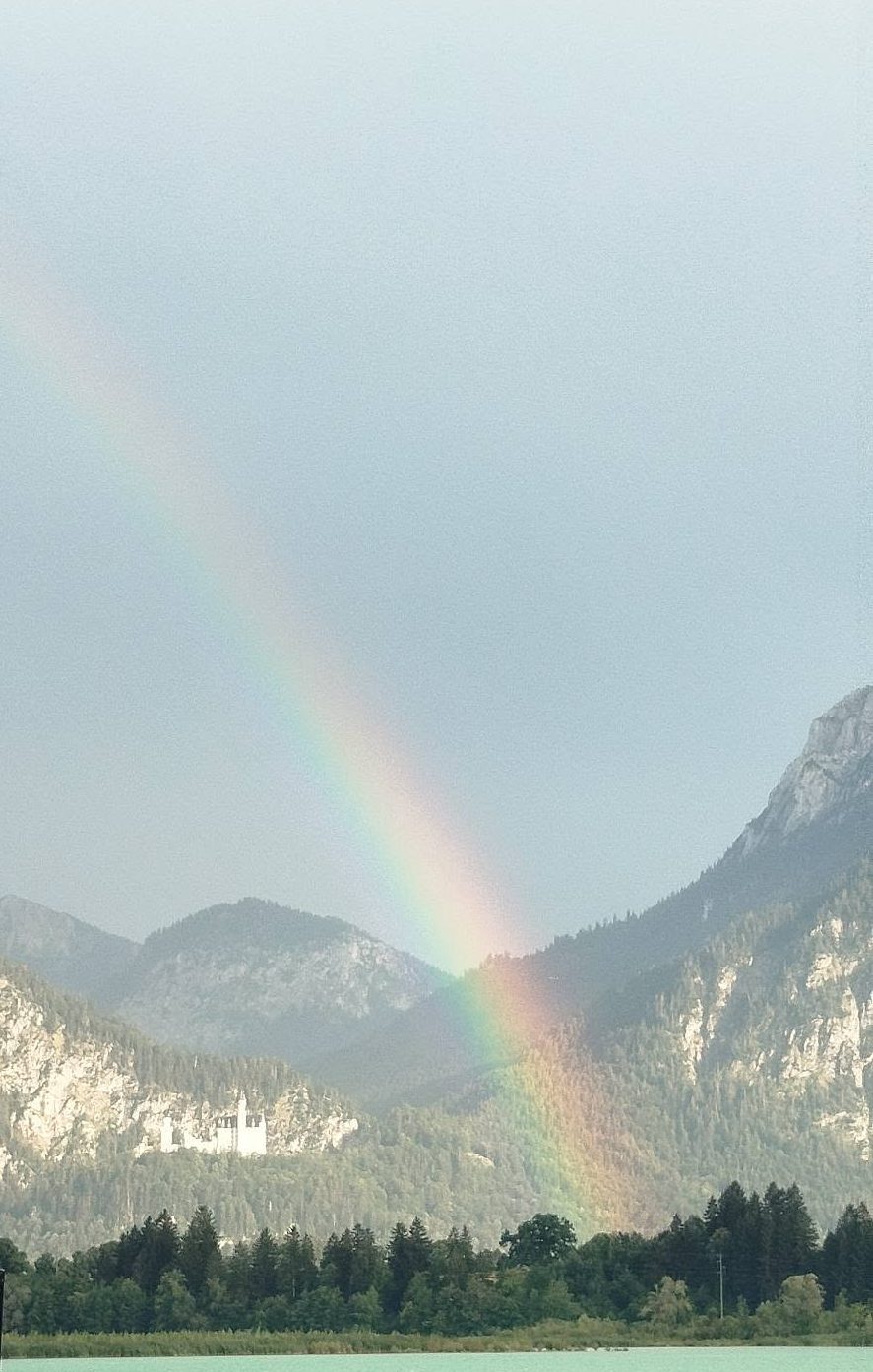
And at eight o’clock, David Garrett walked out and began.
Some people around us said — only half joking — that he’d brought the sun back with his smile. I checked the smile against my own footage afterwards. I’m not prepared to rule it out.
• • •
What do I tell you about the concert itself?
That it was spectacular feels both true and beside the point, because what I’ll actually remember is simpler: he was happy. Visibly, continuously, uncontainably happy. I have hours of the evening on my phone, and his smile is in every minute of it — between pieces, during pieces, at the orchestra, at the band, at a garden full of people who had stood under a black sky refusing to go home and were now being repaid with interest.
The screen pulsed its heartbeat, the way we described in June when this tour was just a press release and a video clip to us — and there it was, ours now, beating over a real lake in real weather. Twenty-five years of songs everyone in that garden already knew, rebuilt for orchestra, fired across the water at a World Heritage castle. The light came back on and off the stage, and I mean both halves of that sentence.
And at some point in the middle of it I stopped taking videos and just stood there, doing the arithmetic this trip keeps forcing on me.
Gstaad was about the instruments — six thousand years of wood, handed forward. Verbier was about the festivals — old hands passing to young ones, and the thirteen-year-old from 1994 who grew up to be the man doing the passing. And Füssen? Füssen closed the triangle. Füssen is what all that handing-down is for. Not the church, not the academy, not the connoisseurs — the garden full of ordinary people in rain ponchos, singing along to a violin. Ludwig built the castle so music would have somewhere to live. The millennium built the theatre so everyone could get in. And on the last night of July, between the two of them, under a rainbow with suspiciously good timing, the whole apparatus did exactly what it was built to do.
We left soaked, shaking — adrenaline, not cold — and grinning like people who knew something the motorway didn’t.
Because we did know something. Four days later, a PDF with fifteen questions went off to his management. Somewhere in Germany right now there is a phone, and on that phone there may soon be voice notes, and in those voice notes there may be the biggest conversation this website has ever carried. We’re not announcing anything. Deals like ours go through management, as a wise man told me — and management will decide, and we’ll be patient, and whatever arrives, you’ll read it here first.
And I’ll admit what’s actually at stake, for us. This site began, four months ago, as a way of saying thank you — to one violinist, from the people in the seats. A tribute. And the one thing a tribute never gets, by definition, is an answer. It talks toward the stage, lovingly, forever, one way. If those voice notes come, then somewhere between a church in Saanen and a skull changing hands beside a Bavarian lake, the conversation stopped being one-way.
But I’ll tell you this much: he kept the necklace.
And the next name on this trip’s itinerary is Salzburg, in September.
See you at stop four.
— S.
• • •
Written from Füssen. Stop three of The Strings Society on the road. The concert took place on Friday 31 July 2026 in the Barockgarten am Festspielhaus, Füssen — part of the Königswinkel Open Airs — on David Garrett’s Millennium Symphony open-air tour, which we covered when it opened in June. The Festspielhaus Neuschwanstein opened on 7 April 2000; its amphitheatre follows Wagner’s “democratic theatre” model, and the building is aligned on its axis with Neuschwanstein Castle, four kilometres across the Forggensee — Germany’s largest reservoir by surface area, filled each spring and let out each autumn. Neuschwanstein was begun by Ludwig II in 1869 in homage to Richard Wagner, and was inscribed on the UNESCO World Heritage list on 12 July 2025. Stop one, Gstaad, is here and here; stop two, Verbier, is here.