I (Didn’t) Have Enough
We are on the road.
That’s the shape this summer has taken, and I don’t think we planned it so much as we were pulled along by it. Stop one was Gstaad: the seventieth Menuhin Festival, the frescoed church at Saanen, six thousand years of wood in one room, David and those violins, and a night I’m still not finished writing about. (If you missed it, it’s here and here.)
Stop two is Verbier.
One night later. One valley over — well, a hundred kilometres and a whole Rhône in between, ninety minutes of road that the Alps make feel longer. You come down out of the Saanenland and out of canton Bern, cross the valley floor at Martigny, and climb again into the Valais until the road delivers you onto a south-facing terrace at fifteen hundred metres, with the mountains stacked up in front of you like an audience that got there early.
And then you notice something strange. You have crossed a canton, a language border and a mountain range, walked into a completely different church — and you are, unmistakably, in the middle of the same conversation.
That’s what this is about.
• • •
Here’s the thing I keep turning over.
Gstaad, 1957. Yehudi Menuhin — the most famous violinist alive at the time — falls in love with a small Bernese village and starts a festival there. Six years later, in England, he founds a school for children. He spends the rest of his life insisting that the point was never his career; the point was the handing down. Seventy years on, Daniel Hope leads both the festival and its string academy, and builds his first season around encounters between generations.
Verbier, 1994. Martin T:son Engstroem — an impresario who had spent his life around the very biggest names in music — has an idea he starts working on in 1991 and opens three summers later, in a village in the Valais. Not, in the end, a festival of stars. A festival where the stars teach. The Verbier Festival describes its own mission, in its own words, as building “a community of exchange between great masters and young artists from all over the world.”
Thirty-seven years apart. Two valleys, two cantons, two different languages at the bakery. And the same bet, placed twice:
At Verbier, that bet is not a side programme. The Academy is described by the festival as “at the heart of the Verbier Festival’s identity” — “a laboratory where the talents of tomorrow are discovered and shaped.” More than a hundred masterclasses, rehearsals and performances each summer. Alumni from over sixty countries. Orchestra training programmes the festival itself calls “a rite of passage for today’s exceptional young orchestral musicians and conductors” — and, downstream of all that, the Verbier Festival Chamber Orchestra, built entirely out of graduates and sent around the world as the festival’s ambassador.
Its thirty-third edition ran 16 July – 2 August this year. The roster is the sort of list you read twice: Salonen, Argerich, Kissin, Renée Fleming, Rattle, Harding, Takács-Nagy, Shani — and then Yunchan Lim, Bruce Liu, Alexandre Kantorow, and a world premiere by a sixteen-year-old Georgian composer, Tsotne Zedginidze. And the Academy marked ten years of its Prix Yves Paternot by bringing a decade of laureates back to Verbier — artists shaped here, now working everywhere — to play together on one stage.
Read that list again and you’ll see it isn’t a line-up. It’s an escalator. Everybody on it is standing somewhere different, and everybody on it is moving in the same direction.
Menuhin would have recognised it instantly. He’d probably have grumbled that someone got there second.
• • •
Monday 27 July. Half past seven in the evening. The Église de Verbier — a modest mountain church, not a concert hall, which by now I’m starting to think is where this music actually wants to live.
On the poster: Peter Mattei, the Swedish baritone, one of the great voices of our time. Mischa Maisky. Kian Soltani. Clara-Jumi Kang. Yamen Saadi. Stephen Waarts. Máté Szücs. Sunwook Kim at the piano. Emmanuel Laville’s oboe. And, at the harpsichord, Julien Quentin — but I’m getting ahead of myself.
(Worth knowing, for later: that same afternoon, a few hundred metres away, the sixteen-year-old Tsotne Zedginidze heard his own Piano Quintet played in public for the first time. Hold on to that. It matters in about ten minutes.)
The festival’s own description of the evening was one sentence long: an original programme paying tribute to the two Leipzig masters, Bach and Mendelssohn. Two works. That’s all.
interval
Johann Sebastian Bach — “Ich habe genug,” Cantata BWV 82
It looks, on paper, like a pleasant Monday. A charming early sextet, a beloved cantata, home by nine.
It is not that. It is one of the most quietly loaded programmes I’ve ever sat down in front of, and it took me most of the first half to work out why.
• • •
Start with the Mendelssohn, because the Mendelssohn is a piece of arithmetic.
He wrote it in April and May of 1824. The manuscript is dated 10 May 1824. Which means the person who wrote it was fifteen years old.
Fifteen. Writing a four-movement sextet for an ensemble nobody had asked for — piano, violin, two violas, cello and double bass — a scoring that leans deliberately dark and low, and lets the piano run the room like a small concerto. A teenager, inventing his own instrumentation because the existing ones weren’t quite the colour he wanted.
In Verbier it fell to six players — Sunwook Kim at the piano, Clara-Jumi Kang, Máté Szücs and Blythe Teh Engstroem on the two violas, Kian Soltani, and Brendan Kane’s double bass holding the floor — and that low, wood-dark sound is exactly right for a church made of mountain timber.
Here’s the part that gets me. He never heard it in public. There’s no record of a performance in his lifetime; he never even mentions it in his letters. It was published in 1868 — twenty-one years after he died — and given the number Op. 110, an old man’s opus number stuck onto a fifteen-year-old’s afternoon.
So the first half of the evening is a boy’s music, arriving a century and a half late, played in a church full of people by an ensemble that included musicians at every stage of the exact journey he was on.
And if you know what that boy did next, the whole programme detonates.
• • •
Because five years later, at twenty, Felix Mendelssohn stood in Berlin on 11 March 1829 and conducted the St Matthew Passion.
It was the first time the work had been heard outside Leipzig, and the first time in something like a century that it had reached a wide public at all. Bach — Bach — had shrunk to a specialist’s rumour, a name for organists and pedants, a Kantor whose manuscripts sat in cupboards. And a twenty-year-old took him out of the cupboard, put him in front of a Berlin audience, and handed him back to the world.
A great deal of what we know about Bach, we know partly because a young man thought an old man was worth carrying.
Now go back and look at that Monday programme again.
Somebody built that. Somebody put the boy before the master, in that order, on purpose. And in a festival whose entire architecture is old hands and young hands on the same stage — on a day that had already given a sixteen-year-old his first premiere, four hours earlier, down the road — that running order stops being programme-note cleverness and becomes a statement of belief.
The young ones don’t just inherit the music.
That’s not a Verbier idea or a Gstaad idea. It’s the same idea, and it has been running between these mountains, and between these centuries, the whole time.
• • •
And then the second half arrives, and undoes you.
Bach wrote Ich habe genug for Leipzig, first performed on 2 February 1727, for the Feast of the Purification. The text comes from Luke — from Simeon.
You know the story even if you don’t know you know it. Simeon is an old man who has been promised he will not die before he sees the child. He waits his whole life. And then one ordinary day a young couple carries a baby into the temple, and Simeon takes the child in his arms, and says: now, Lord, let your servant go in peace.
That is the whole cantata. Five movements. An old man holding the future in his two hands and discovering that he is finished — not defeated, not resigned. Finished in the good way. Full.
Then the slumber aria — Schlummert ein, ihr matten Augen, “fall asleep, you weary eyes” — where Bach does something almost unfair: the music stops pressing forward. It just settles. Long held notes, the harmony pooling, fermatas where you expect motion. Time goes soft. And Peter Mattei, who can do enormous things with a voice, spent that aria doing the hardest one — almost nothing, beautifully — while the strings breathed underneath him and the church went so quiet you could hear the building.
And the last movement is a man saying he’s looking forward to the end. Cheerfully. In a major key. Which should be unbearable and somehow is the opposite.
I sat there in that little church, one night after Gstaad, and I finally understood what I’d been watching all week.
Menuhin founding schools instead of protecting a legend. Hope running the academy in Gstaad seventy years on. David putting a quarter of a billion dollars of violins on a stage and giving the money to children he’ll never meet. Engstroem building a festival whose proudest product is other people’s careers. Mendelssohn at twenty, carrying an old man out of a cupboard.
All of them are Simeon.
That’s the whole business. That’s what a festival is for. Not the applause — the transfer. And you can dress it in a Guarneri or a harpsichord or a mountain village, but it is always, underneath, the same gesture: someone handing something forward, and being glad about it.
I have enough. What a thing to be able to say.
• • •
I want to be careful here, because I only found this out afterwards, and finding it out rearranged the entire week for me.
Everything above — the boy who wrote the sextet, the young man who carried Bach out of a cupboard, the sixteen-year-old with a premiere down the road, the whole argument that the young ones are how the music survives — I wrote thinking I was describing a pattern. Something that happens to festivals in general. A nice idea about the Alps.
Then I went looking at Verbier’s own history.
12 July 1994. The opening concert of the very first Verbier Festival. Martin Engstroem’s brand-new idea, its first evening, its first audience, its first note. The Young Israel Philharmonic on stage. Zubin Mehta conducting.
And the soloist was a thirteen-year-old boy from Aachen.
I had to read it three times. The festival’s own archive says it plainly: “On 12 July 1994, David Garrett, then aged 13, performed at the opening concert of the 1st Verbier Festival with the Young Israel Philharmonic under Zubin Mehta.” Thirteen years old. Not a guest slot on the third Tuesday — the opening. The first thing this festival ever did, in front of anybody, was hand the stage to a child.
He came back the next summer as an Academy student — that’s where the 1995 photograph comes from, the one where he’s fourteen and all hair — and studied there with Isaac Stern. He is on the Academy’s list of success stories to this day.
And Engstroem, twenty years later, explained the house rule in one sentence: “In Verbier, nurturing talent is not a one-off. Once we have identified a talented musician — whether a young soloist, as in Garrett’s case, or a young orchestral player — we accompany them over years, through their training and the building of their career.”
As in Garrett’s case.
So sit with the shape of this for a second.
Two summers, two mountains, two stops on a small trip we took for the love of it. In Gstaad we watched a man in his forties put a fortune in violins on a church stage and give every franc of it to a school for children he will never meet. Then we came ninety minutes over into the next canton and sat down in another church — and discovered that the same man was one of those children. That thirty-two years ago, this festival’s very first act was to point a light at him.
I have spent this whole story saying that the transfer is the point. I did not know, while I was saying it, that I had been watching one complete cycle of it — from the thirteen-year-old on the receiving end in 1994 to the man doing the giving in 2026 — with two nights and one mountain range in between.
And he isn’t finished with this place either. On 27 July 2026 — the very day of the concert I’ve been describing to you, while we were somewhere in that village killing time before half past seven — the Verbier Festival held a press presentation and announced it was extending its partnership with the city of Shenzhen through 2027 and 2028. The first Shenzhen edition, last February, ran twenty-four concerts and seven public masterclasses and drew more than twenty-three thousand people. The second runs 9–18 February 2027.
Look at who is on the list for it.
David Garrett. And Clara-Jumi Kang. And Mischa Maisky. And Kian Soltani. And Blythe Teh Engstroem. And the Verbier Festival Chamber Orchestra — built entirely out of Academy graduates — under Gábor Takács-Nagy.
Which is to say: very nearly the exact people who were standing in front of me that Monday night, plus the boy from the 1994 opening concert, going together to a country where this festival is two years old, to do the whole thing again from nothing, in front of an audience that has never seen it.
The release puts it better than I can. The partnership, it says, reflects a shared conviction:
Renews itself. Not preserves itself. That is the whole difference, and it is the difference this trip has been about from the first note in Saanen.
• • •
Which brings me, finally, to the reason this stop was never going to be only about a festival.
Under all of that Bach — holding the whole cantata up from underneath, doing the least visible and most load-bearing job in the building — sat Julien Quentin.
Some of you will already know the name from our conversation with him. French, born in Paris, trained in Geneva, then Indiana, then Juilliard; based in Berlin now, where he runs Musica Litoralis at the Piano Salon Christophori, a series he built to feel like a 1920s salon rather than a concert. He plays with more or less everybody — Emanuel Ax, Lisa Batiashvili, Gautier Capuçon, Sol Gabetta — and, as our corner of the world knows very well, he has spent years on stage beside David Garrett. He also makes electronic music with people you would not expect a Juilliard pianist to be making electronic music with, which tells you most of what you need to know about him.
And on Monday night, one of the finest pianists on that mountain sat at a harpsichord, in the dark, playing continuo. No spotlight. No bow at the end that anyone would call his. Just the floor under everybody else’s feet — and, down there with him in the bass line, Mischa Maisky’s cello.
Think about that for a second. Two musicians who could sell out a hall on their names alone, spending an evening holding up somebody else’s aria. Nobody in that church went home saying “what a continuo.” That is precisely the point.
Of all the things I saw that week, that might be the one that says the most.
And one more thing, which I also only found afterwards, and which made me laugh out loud when I did.
20 July 2011. Église de Verbier. Eleven in the morning. A duo recital: Brahms’s Third Sonata, Mozart’s K. 301, Beethoven’s “Spring.” Two names on the poster — David Garrett and Julien Quentin.
That church. This church. The one we were sitting in.
Fifteen years earlier, in the same four walls, in the same mountain village, the two men at either end of our little trip had stood up and played Beethoven together. We came here for a Bach cantata and a friend, straight from a night that belonged to David, and sat down inside a room that had already had both of them in it.
You start to feel, after a while, that this world is not very large and that it keeps its receipts.
• • •
It took a couple of messages. That was all. A few lines back and forth before the concert, the sort of thing you send half-expecting to be politely ignored — and then, after the applause had emptied out of the church, there he was.
I should be honest about what we were, from his side of it. Two people he had never met. Two names attached to some writing on a screen. Two weird strangers, frankly, turning up in a mountain village at ten o’clock at night to say hello to a musician who had just finished a Bach cantata.
And Julien was adorable. Exactly as adorable as he always is — which those of you who’ve read our conversation with him will already have guessed. Smiling. Unhurried. Warm in that completely unperformed way that you cannot fake at half past ten at night after a concert, when the only thing anyone would forgive you for is wanting to go to bed.
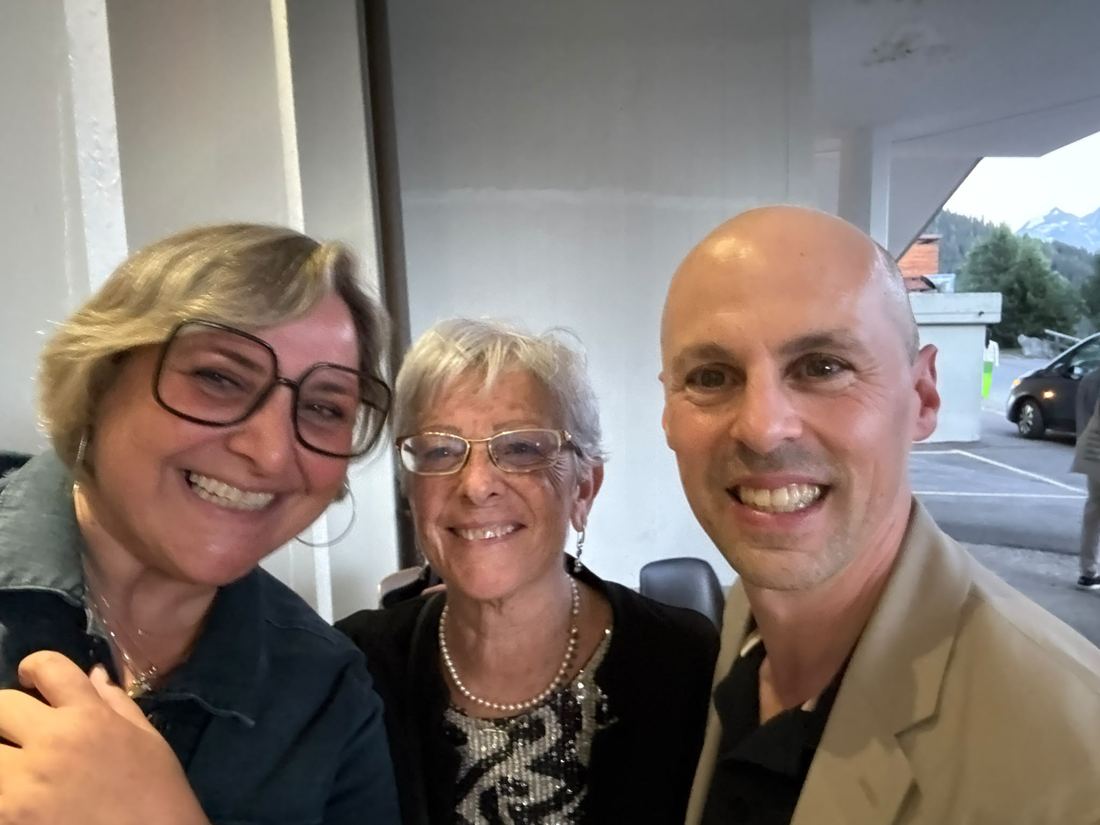
We talked for a while, out in the cool air with the mountains doing their black-shape thing behind the roofs.
We talked about David’s night in Gstaad — the violins, the church at Saanen, that whole impossible evening, still less than forty-eight hours old and already feeling like something we’d have to spend the rest of the year explaining to people. We talked about the Menuhin Festival, and about Verbier, and about what these two places are actually doing up here in the Alps, which is more or less the argument of everything you’ve just read.
And we talked about Daniel Hope.
Which stopped me, a little, when I realised what was happening.
Because Julien and Daniel have worked together often — and especially, he told us, in Berlin during the pandemic. Those were the Hope@Home years: March 2020, the world shut, and Daniel Hope turning his own Berlin living room into a broadcast studio and putting out a concert a day. Seventy episodes in the first run. Something like a hundred and fifty in the end, once it went on tour and across Europe. More than four hundred musicians came through it. Close to eleven million streams. Music given away, free, to people who could not leave their houses — and a lifeline thrown to players with no stages left to stand on.
That was Berlin, in the worst year anybody can remember. And it is, when you look straight at it, the same gesture again: somebody with a platform handing it to everyone else.
And Daniel Hope is who we’re speaking to next.
So there we were: standing outside a church in Verbier, talking to a friend we’d made through a microphone, about a man we’re about to meet, who runs the festival we’d been in the night before, which was founded by a violinist who spent his life insisting the point was the handing down. The Domino Effect, once again.
Everything in this story — Simeon, Mendelssohn, the academies, the continuo line nobody applauds — I’d been describing as something that happens to music.
That night I understood it also happens to people. It had just happened to us. A musician who owed us nothing gave us twenty minutes of a night he’d earned the right to keep for himself, and in the middle of it, without meaning to, handed us the next door.
See you at stop three.
— S.
• • •
Written from Verbier. Stop two of The Strings Society on the road. The 33rd Verbier Festival ran 16 July – 2 August 2026; the concert took place on Monday 27 July at 19:30 in the Église de Verbier, with Peter Mattei, baritone, Sunwook Kim, piano, and Julien Quentin, harpsichord. The 1994 opening-concert detail comes from the Verbier Festival’s own history; the Shenzhen announcement from the festival’s media release of 27 July 2026. Stop one was the 70th Menuhin Festival Gstaad, and it’s here.