A Love Theme, Played for Someone
Ennio Morricone conducting. © Featureflash | Megapixl.com
In 1950, a young woman named Maria Travia was recovering from a car accident in Rome.
She was a friend of Adriana Morricone, whose brother Ennio was studying music.
She had been hurt badly enough to be put in a plaster cast. Ennio began visiting her. He stayed close while she recovered, and somewhere in those weeks the balance between them began to change.
Years later, he described how he had won her heart: goccia dopo goccia. Drop by drop.
He did not particularly believe in love at first sight. He believed in constancy, coherence, loyalty. The same qualities, he thought, that mattered in art.
Ennio and Maria married in Rome on 13 October 1956.
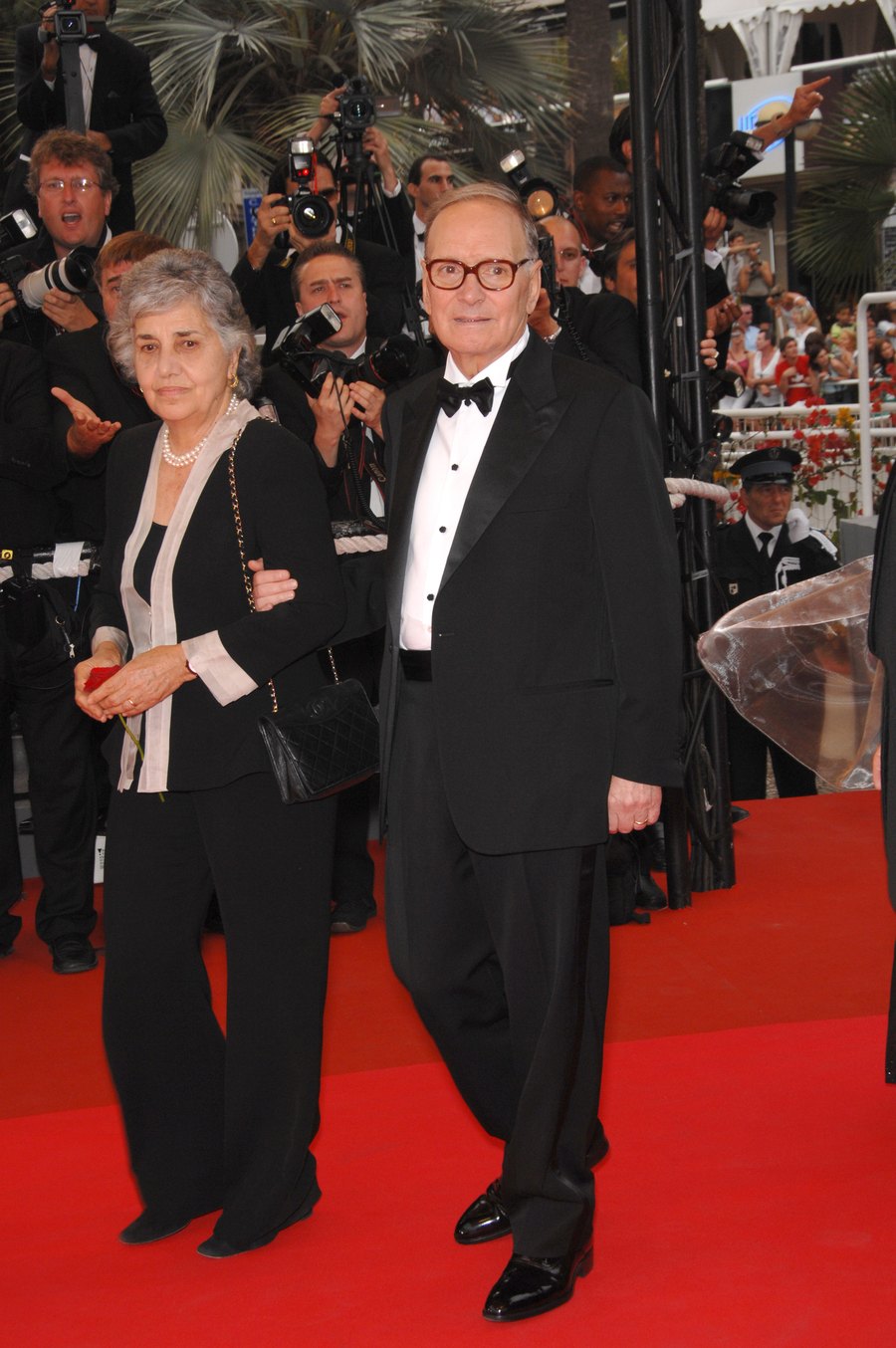
He would spend the next six decades composing music that millions of people would fall in love with. Maria would remain the person whose opinion mattered first.
Ennio Morricone was born on 10 November 1928. Today would have been his ninety-eighth birthday.
And although there are hundreds of compositions we could choose to remember him by, we would like to begin with a love story.
• • •A trumpet, a pencil, and a remarkable ear
The first instrument was a trumpet.
Ennio’s father, Mario, was a professional trumpeter, and music was both an art and a means of earning a living. The young Morricone studied at Rome’s Conservatorio di Santa Cecilia, eventually completing his composition studies under Goffredo Petrassi.
He learned the discipline of the concert hall and the possibilities of modern music. He also learned how to arrange popular songs, how to make an orchestra do unexpected things, and how to write for musicians who had to get the notes right the first time.
That combination would change the sound of cinema.
Think of The Good, the Bad and the Ugly. The whistle. The voices. The electric guitar. The sounds that seem to belong as much to the landscape as to the orchestra.
Or Once Upon a Time in the West, where a harmonica becomes inseparable from a man’s history, and Edda Dell’Orso’s extraordinary voice seems to rise out of the landscape itself.
Then there is Once Upon a Time in America, with the aching tenderness of Deborah’s Theme. And The Mission, where the oboe carries a melody into a world in which words have failed to establish trust.
Morricone could make an instrument sound like a memory. He could make a human voice feel like a place.
He was just as interested in what happened when familiar sounds were pushed beyond their usual boundaries. During the 1960s, while his film scores were becoming internationally famous, he was also playing with the experimental Gruppo di Improvvisazione Nuova Consonanza, exploring improvisation, unconventional instrumental sounds and the spaces between them.
It is tempting to divide him into the composer of beloved melodies and the musician of the avant-garde.
But listen to those westerns again.
The experiments were there all along.
For all the invention, his working habits were remarkably traditional. Pencil and manuscript paper. Long hours. A private room in which to think.
And then, when the music was ready, there were people waiting to hear it.
Among them was Maria.
• • •The music came home first
For someone whose work reached audiences around the world, Morricone guarded the privacy of his working life.
He was famously disciplined, demanding of himself and protective of the concentration composition required. His home was not a place where music played constantly in the background. Music was something to be made, considered and listened to.
His family knew the difference between a day when he was working and the moment when he was ready to share what he had written.
One of the loveliest things about the recollections of those closest to him is how little they resemble the public image of a celebrated composer.
There is no grand orchestra in these memories. No red carpet. No standing ovation.
There is a father calling his son into another room.
And that brings us to a melody almost everybody knows, though not everybody knows who wrote it.
• • •A phone call down the hall
In the late 1980s, Giuseppe Tornatore was preparing a film about a boy growing up in a Sicilian village, the cinema he loved, and the projectionist who became something like a second father.
The film was Nuovo Cinema Paradiso.
Ennio Morricone was composing its score. His son Andrea, then twenty-four and still studying at the conservatory, was at home when his father called him on the house telephone.
He had a screenplay, Ennio explained, and he would like Andrea to try writing something for it.
Andrea composed a melody and took it to his father.
Ennio liked what he heard. He added two chords, a small intervention with a remarkable effect, giving the theme a circular quality, so that its ending seems to find its way back to its beginning.
He included the piece among the music proposed to Tornatore.
The director chose it.
It became the Love Theme from Cinema Paradiso.
That melody, so often associated simply with Ennio Morricone, was composed by Andrea Morricone, with his father’s contribution to its final shape.
And Ennio was determined that people should know.
Andrea has recalled how his father made a point of identifying the piece as his son’s work. He continued to praise it over the years, even as Andrea protested that his father had written so much extraordinary music himself.
There is something wonderfully generous about that exchange.
A composer whose name had become synonymous with film music was not interested in claiming another beautiful melody for himself.
He wanted the world to know whose it was.
At a concert at Rome’s Baths of Caracalla, Ennio even handed Andrea the baton so that he could conduct the piece.
Imagine that moment.
The son who had once been called down the hall to try writing a melody was now standing in front of an orchestra, conducting it while his father stepped aside.
Cinema Paradiso went on to win the Academy Award for Best Foreign Language Film. Tornatore and Morricone continued working together for decades, producing music that could be intimate, nostalgic, exuberant or devastatingly restrained.
But there is something about the Love Theme that makes it especially fitting for this story.
It was written by a son, encouraged by a father, for a film about the people who shape our lives and the things we carry away from them.
And then it began travelling.
• • •Saanen, 26 July 2026
This summer, we heard that melody again, in the church at Saanen, in Switzerland, during Masters of Sound at the Gstaad Menuhin Festival.
Cristian Fatu was holding the violin the programme gave as the 1729 “Bériot” Guarneri del Gesù, the instrument we wrote about in Bériot’s Concerto, Bériot’s Violin. He could have shown it off with Bériot’s concerto, the piece he had won with as a boy.
Instead, with pianist Julia Okruashvili, he played the Love Theme from Cinema Paradiso, and dedicated it to his girlfriend.
Cristian Fatu, violin; Julia Okruashvili, piano. Love Theme from Cinema Paradiso, Kirche Saanen, 26 July 2026. Video: Daniel Waldhecker, used by permission.
• • •For Maria
On 25 February 2007, Ennio Morricone walked onto the stage at the Academy Awards to receive an honorary Oscar.
Clint Eastwood presented it.
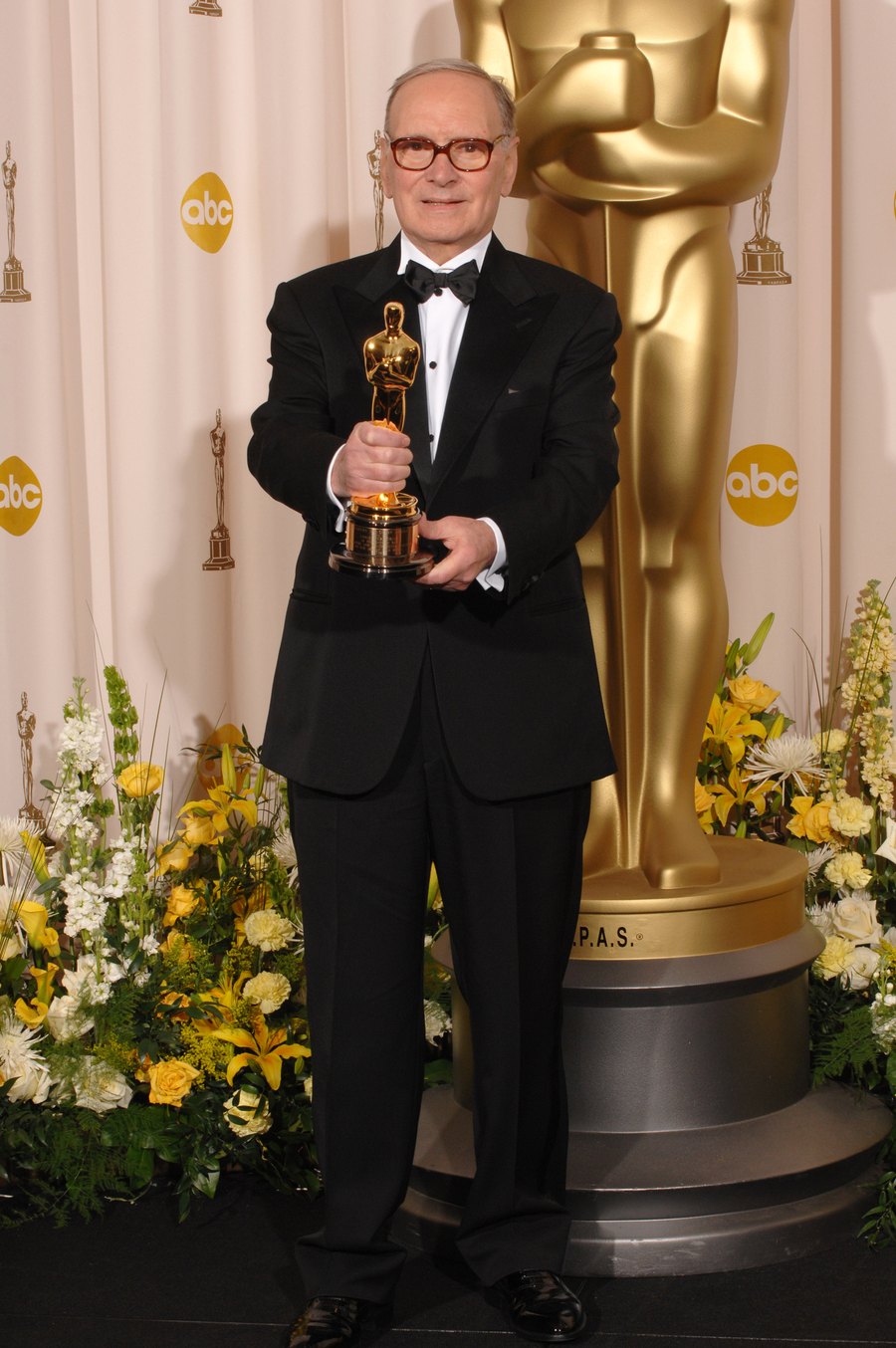
Morricone had already received five nominations for his film scores without winning a competitive Academy Award. Now, at seventy-eight, he was being honoured for a lifetime of work.
He thanked the Academy, the directors who had trusted him and the artists whose achievements deserved recognition.
And he dedicated the award to Maria.
It was a public declaration from a man who had spent much of his life expressing emotion through notes rather than speeches.
Nine years later, in 2016, he finally won a competitive Oscar for The Hateful Eight. Once again, Maria was part of his thanks.
There had been so much music between those two ceremonies.
Gabriel’s Oboe. Deborah’s Theme. The theme from Cinema Paradiso. The strange, unforgettable sounds of Leone’s westerns. Concert works, chamber music, experiments and melodies that had travelled further than their composer could ever have followed.
But the person to whom he returned, in the most public moments of his life, was the woman he had visited in hospital in 1950.
The woman he had courted, as he put it, drop by drop.
• • •The last words
Ennio Morricone died in Rome on 6 July 2020, aged ninety-one.
He had prepared his own farewell.
It was characteristically direct. He announced his death himself, thanked his friends and family, and explained that he wanted a private funeral because he did not wish to disturb anyone.
He remembered his sisters, his children and his grandchildren.
And then he came to Maria.
He wrote of the extraordinary love that had kept them together, and of the sorrow of having to leave her.
He called it il più doloroso addio.
The most painful goodbye.
Today, on his birthday, we could remember Ennio Morricone with the sound of a trumpet, a whistle in the desert, an oboe, or an orchestra swelling beneath the final scene of a film.
We could remember him through the countless musicians who continue to play his music.
Or through a young composer answering his father’s telephone call.
Or a violinist in a Swiss church, playing a love theme for someone he loves.
Perhaps that is one of the loveliest things music can do.
A melody begins in one life, and finds a home in another.
Buon compleanno, Maestro.
Sources: Andrea Morricone, interview with Panorama; Sky TG24 on Maria Travia; the Academy of Motion Picture Arts and Sciences (speech transcript, 2016); Libreriamo (2007 speech); OperaWire, ANSA and Live Sicilia (July 2020); Cristian Fatu, from the stage at “Masters of Sound”, Kirche Saanen, 26 July 2026, and in conversation with The Strings Society. Cover photograph: © Fabiodiena | Megapixl.com.