The Chair at Checkpoint Charlie
Mstislav Rostropovich at Checkpoint Charlie, 11 November 1989.
The first thing Mstislav Rostropovich needed was a chair.
He had brought his cello all the way from Paris. He had found his way to the Berlin Wall, where people were climbing over the concrete, embracing strangers and crossing a border that, only days earlier, had seemed permanent.
But a cellist cannot play standing up.
So he asked someone nearby for a chair.
And on 11 November 1989, beside Checkpoint Charlie, one of the world’s greatest musicians sat down in the street and began to play Bach.
There was no concert programme. No stage. No invitation.
He had come because he needed to be there.
• • •
Two halves of a life
Two evenings earlier, on 9 November, an East German official had announced new travel regulations at a televised press conference. Asked when they would take effect, Günter Schabowski gave an answer that changed history: immediately, as far as he knew.
The border guards had received no clear instructions for what followed.
Thousands of people made their way to the crossings. The crowds grew, the pressure mounted, and eventually the barriers opened.
In Paris, Rostropovich watched it happen, live on his television.
For most of the world, the opening of the Berlin Wall was an extraordinary political event. For Rostropovich, it was also deeply personal.
In 1969, he had offered refuge at his home to the writer Aleksandr Solzhenitsyn, whose work had brought him into conflict with the Soviet authorities. Rostropovich later defended him publicly, and his own career in the Soviet Union suffered.
Performances were cancelled. His freedom to travel was restricted. The musician who had been celebrated as one of his country’s greatest artists became increasingly unwelcome at home.
In 1974, Rostropovich and his wife, the soprano Galina Vishnevskaya, left the Soviet Union with their family.
Four years later, the Soviet government stripped them of their citizenship.
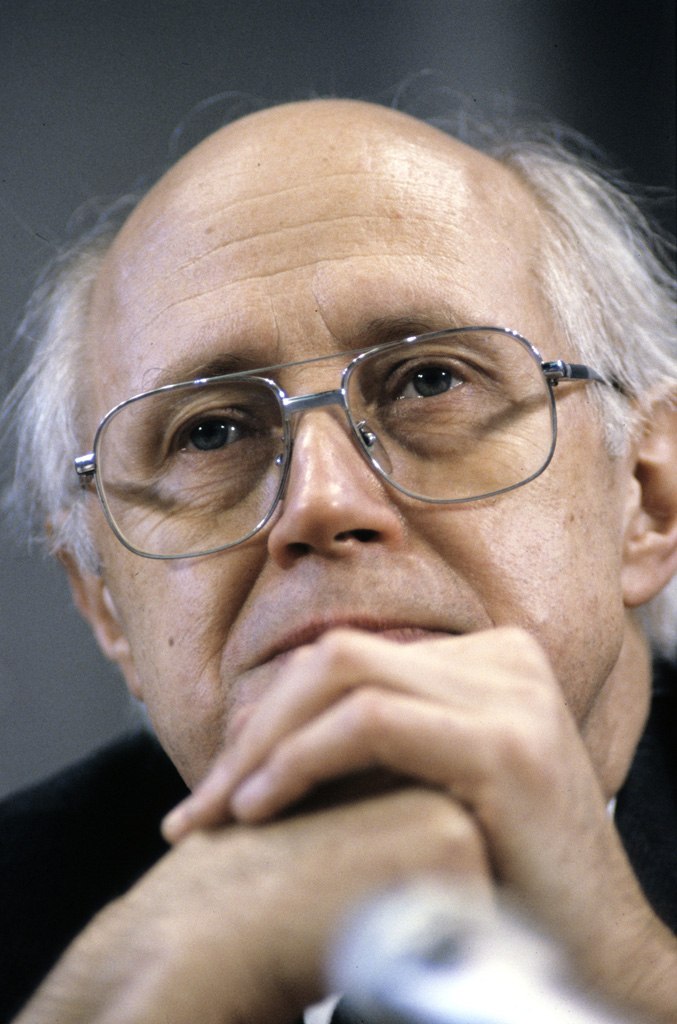
He would later say that going to the Wall that day allowed him to unite the two parts of his existence that had been forcibly divided.
And now, suddenly, the Wall was opening.
He telephoned his friend Antoine Riboud, the French industrialist, who had access to a private aircraft.
They flew to Berlin with the cello.
Rostropovich did not arrive with a carefully prepared programme or an orchestra waiting for him.
He took a taxi to the Wall.
The one thing a cellist needs almost as much as his instrument.
• • •
Bach, in two different keys
At first, only a small group gathered around him.
Some recognised the musician sitting beside the graffiti-covered concrete. Others stopped because there was music where, until very recently, there had been a heavily guarded border.
He began with Bach: the most joyful movements of the solo cello suites.
He was celebrating.
It is worth remembering what those suites are. Bach wrote them for a single instrument, without an orchestra or accompaniment. Their movements draw on dance forms: preludes, allemandes, courantes, sarabandes and gigues.
Music that can fill a concert hall with one musician alone.
On that November day, it had to compete with the noise of an extraordinary city.
People were calling to one another, moving between East and West, discovering streets and faces that had been kept apart for twenty-eight years.
And through it all, Bach.
But Rostropovich could not think only of the people who were celebrating.
He remembered those who had died trying to cross the Wall.
He spoke to the people gathered around him, explaining that he wanted to play something in their memory.
Then he turned to the Sarabande from Bach’s Second Cello Suite, in D minor.
The change was unmistakable.
A sarabande is a slow dance. In this one, the music seems to move carefully, almost reluctantly, as though every note needs time to settle before the next can begin.
The cellist had arrived to celebrate freedom. He had found himself remembering its cost.
• • •
The other 11 November
Seventy-one years earlier, on 11 November 1918, an armistice brought the fighting on the Western Front to an end.
The guns fell silent at eleven in the morning.
Among the French soldiers who survived the First World War was a young cellist named Maurice Maréchal.
He had been a promising student at the Paris Conservatoire when war broke out in 1914. Instead of beginning the career he had trained for, he found himself serving in the army, working as a runner near the front.
His own cello was far away.
For a musician, there must be a particular loneliness in that: to have music in your head, the ability to play it in your hands, and no instrument on which to make it heard.
In 1915, two soldiers serving alongside him decided to do something about it.
Their names were Neyen and Plicque.
Both were carpenters in civilian life.
They took wood from an ammunition crate for the top, and an old oak door for the neck, and began building a cello.
It was not an elegant Cremonese instrument. Its body was unusually shaped, its materials improvised, its construction dictated by what could be found in the middle of a war.
But it was a cello.
Maréchal called it Le Poilu, after the familiar name given to French infantrymen.
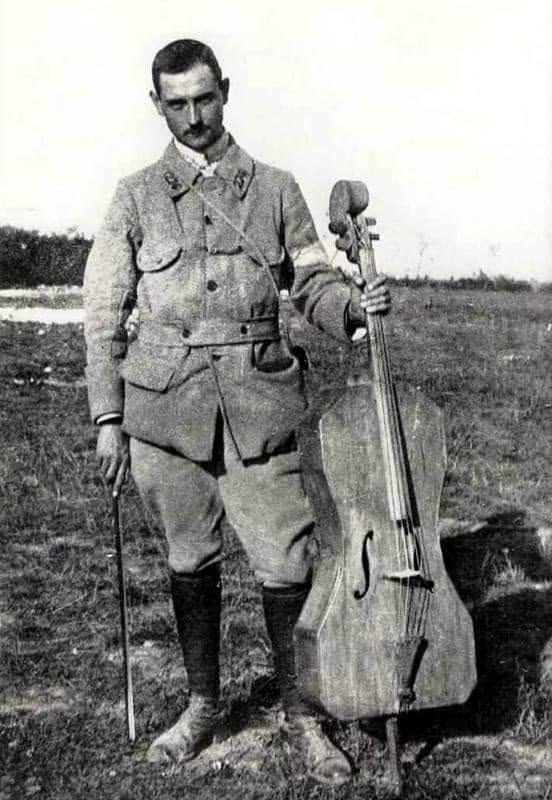
Its makers signed it on 30 June 1915, the day after they handed it over. The mark is still there.
It also carries signatures that would become famous: Foch, Joffre, Gouraud, Mangin and Pétain, generals whose names belonged to the history unfolding around the young musician.
Yet the names that matter most to this story are the two left by its makers.
Neyen and Plicque.
Neither survived the war.
Both were killed in combat barely two weeks after they had finished the instrument.
Their cello survived them.
• • •
What the wood remembered
Maréchal continued playing Le Poilu during the war.
It accompanied him through a world in which ordinary musical life had been almost completely displaced. He played for fellow soldiers and, on occasion, for senior officers.
One can imagine how unusual it must have been to hear a cello there.
But there is no need to invent the scene. The instrument itself is evidence enough.
It was made from materials associated with destruction and given a purpose that had nothing to do with war.
Two carpenters had taken wood available to soldiers and made something capable of producing Bach.
The cello survived the armistice. Maréchal survived too, returning to a distinguished musical career.
Today, Le Poilu belongs to the collection of the Musée de la musique at the Philharmonie de Paris.
Its unusual shape, inscriptions and surviving documentation make it an extraordinary witness to the lives of musicians during the First World War.
And to the two men who built it.
They never heard what became of Europe after 1915. They did not live to see the armistice.
But something they made was still there when the war ended.
More than a century later, it is still there.
• • •
A chair, and a cello
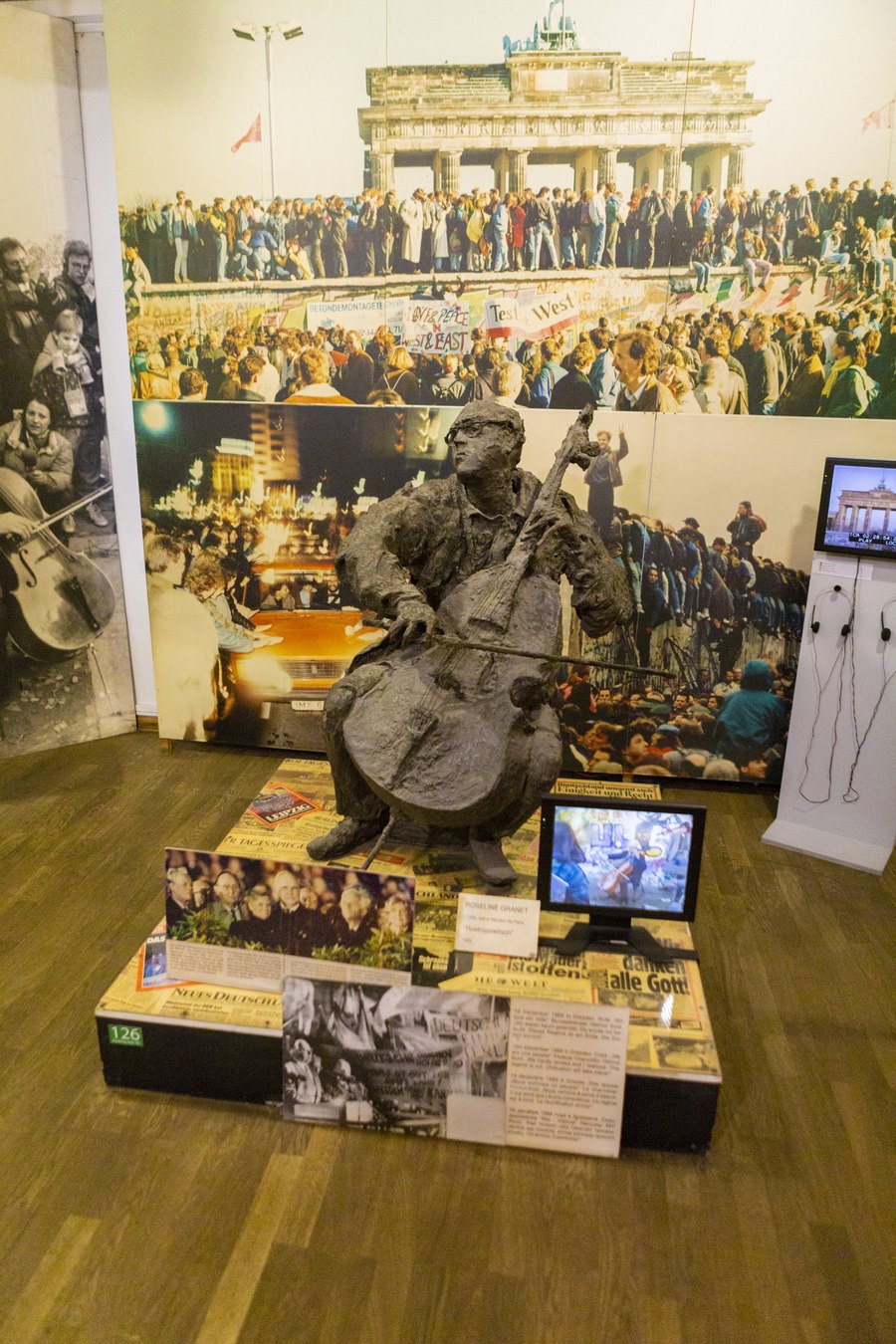
There is no direct historical connection between Maurice Maréchal and Mstislav Rostropovich’s performance in Berlin.
The coincidence of 11 November does not make their experiences equivalent. One lived through a world war; the other experienced political persecution and exile before witnessing the opening of a divided city.
Their circumstances were different. So were the histories around them.
But their instruments allow us to notice something that the great dates in history can sometimes obscure.
We remember the armistice of 1918 through the silence of guns.
We remember November 1989 through crowds on top of the Berlin Wall.
And rightly so.
Yet there were other sounds.
A cello built by soldiers who would not live to see the peace.
A cello played by an exile who had finally seen a border open, but could not forget those who had died beside it.
Neither instrument ended a war or brought down a wall.
Neither could restore the people who had been lost.
But both gave someone a way to answer history with something other than words.
And perhaps that is why the photograph of Rostropovich still moves us.
Not because a famous musician played in an unusual place.
But because, at a moment when the whole world seemed to be shouting, he sat down.
He played for the living.
And then he played for the dead.
All he had needed was a chair.
Sources: Mstislav Rostropovich’s own recollections, in Daily Maverick and The New World (“Great European Lives”); INA (France 2, 1993, Antoine Riboud); nemoskva.net on 15 March 1978; Stéphane Vaiedelich, “Le poilu, violoncelle de Maurice Maréchal”, Culture et Recherche no. 131 (French Ministry of Culture, 2015); Philharmonie de Paris, via Google Arts & Culture; Mémorial de Verdun.