An Afternoon with Mozart
We all follow Deutsche Grammophon. Let's admit it, there's no denying it: the Gotha of classical music, and the first place melomaniacs like us go looking.
So when their page put a very young, very talented pianist in front of me some time ago, I stopped. And then I started following, digging, exploring and, above all, listening.
Maybe I'm getting older. What keeps growing in me is the need to believe that the next generation — of artists, and of people — still has a chance to prove itself different from what social media reflects back at us. That there is still value, still values, still the will to make music that isn't fixed afterwards — no correction, no filter, nothing tidied up in post. In a purer, rawer way. The kind that — but this is me — really gets you: that inspires, transcends, astonishes.
Delving into Justus Eichhorn's music, that is exactly what I found. Along with a great deal more. His story, his training and his musical maturity are the proof.
So, as we always do — you know us by now — I thought it was worth a try. So I wrote to Deutsche Grammophon and asked for an interview. I got two. But that's for later.
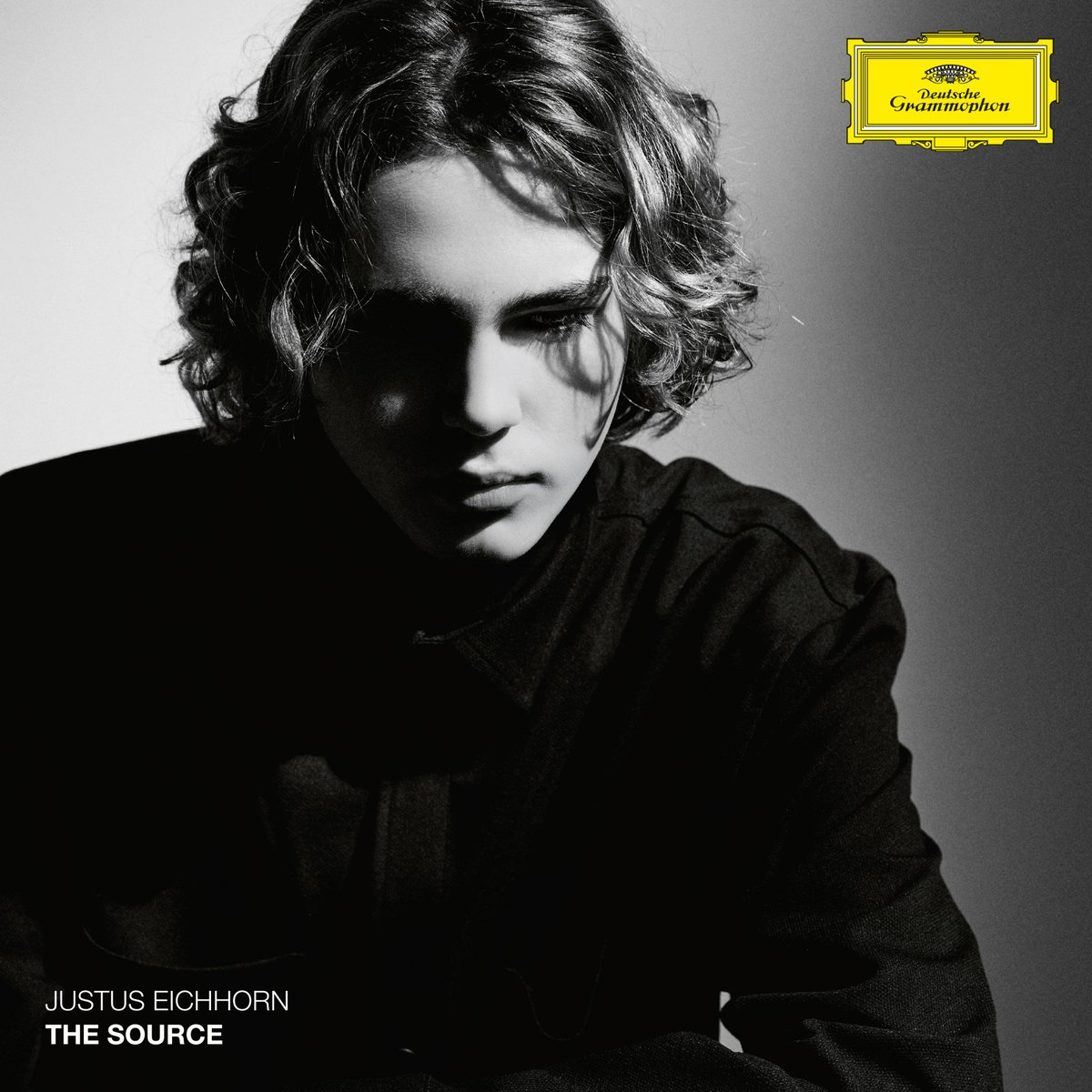
Let me introduce you to what I think is a rising star of the piano. His debut album The Source is out now, and it is something you really do want to hear.
• • •
In the Eichhorn house in Weimar, both parents play the violin. His mother plays the viola as well. His sister played the cello. Justus sat down at the piano.
We are fonder of that detail than we can properly justify. Somebody in every musical family goes their own way, and it is usually a small, quiet decision that nobody records at the time.
He was three when he started improvising, six when the lessons began, nine when he was taken into the Hochschule für Musik Franz Liszt in his own town to study with Grigory Gruzman, which is where he still is, alongside his schooling at the Musikgymnasium Schloss Belvedere and a short spell with Matti Raekallio at Juilliard. He was ten at his first concerto — the Haydn in D. Thirteen when he played Beethoven's Second at the Tonhalle Zürich. Fourteen when he played the Third at the Seoul Arts Center. He has twice been at the Verbier Festival Academy.
He conducts. He composes. He is sixteen now, and on 11 September Deutsche Grammophon released his first record.

We came to him with a theory, and the theory was almost right.
The record is called The Source, and the source is Weimar: a programme drawn from the composers the town has held. Bach was there from 1708, and in one particular stretch between the summers of 1713 and 1714 he sat with a pile of Vivaldi's concertos — music written for strings — and turned them into music for a keyboard. Not out of reverence. To find out how they were built.
Three hundred and twelve years later, in the same town, a sixteen-year-old put his own arrangement of Vivaldi on his first album. So we went to a pianist, and we admit we were pleased with ourselves for the idea.
The theory held. It was also beside the point, and it took one sentence of his to show us why. He didn't come to string music through Bach. He came to it through the room he grew up in.
We sent eleven questions. He took all of them, in German, in writing, and he took them seriously, which is not something a sixteen-year-old with a record out owes anybody. In one of them we spent a whole paragraph explaining that a piano cannot hold a note the way a bow can, and asked him what he does about it. He said he sings, silently, while his hands move. We have thought about that sentence a good deal since.
Here is the whole of it.
The Strings SocietyYour album is called The Source, and the source is the town you were born in. In the summer of 1713, in that same town, Bach sat over a pile of Vivaldi concertos and turned them into keyboard music — not out of reverence, by the look of it, but to find out how the man had built them. On your album there is a Vivaldi arrangement of your own. When you arrange Vivaldi, are you translating him, or taking him apart?
Justus EichhornI'd say I translate Vivaldi, rather. The beautiful melody of the Largo from the Flautino Concerto RV 443 fascinated me so much that I simply had to play it on the piano.
The Strings SocietyThe Largo you chose is a singing line over strings — written for an instrument that can hold a note and then make it bigger. A piano, once the note is there, has only one direction available: away. It's a limitation pianists live with so completely that they hardly name it any more. What do you do with your hands at the moment the music wants a bow — or a breath?
Justus EichhornI love the bell-like sound of a piano, and at the same time I try to sing on it. The hands move almost unconsciously; inwardly I connect the notes. I'm singing along silently, so to speak.
The Strings SocietyYou said about the Czerny études that you wanted "to create a salon-style atmosphere and transform the turbulent études into something more meditative." For most people who ever had piano lessons, Czerny isn't a composer, he's a punishment. What did you hear in those pieces that made you think something would surface if you slowed them down?
Justus EichhornThe Czerny études are incredibly virtuosic, brilliant, sparkling. I think they work very well in concert, too — as encores, for instance. Alongside all that brilliance, I wanted to find out how they'd sound if I approached them from a completely different side: slow, and turned inward. I was astonished that the arrangement produced such meditative, spherical pieces.
The Strings SocietyOn composing, you've said: "I start with images in my mind's eye, and translate their mood and movement into sound." Take one of the three new pieces on the album and describe the image to us. Not the mood — the image. And then: what was the first thing about it that became sound.
Justus EichhornFor my piece Silent Fields, for example, I imagined a cornfield with the wind blowing gently across it. That's where the semiquaver figures came from — for me they are the ears of corn, moving. For Aurelian I had something golden and gleaming in front of my eyes, perhaps something lit by the sun.
The Strings SocietyAlongside playing the piano, you compose as well. The piano is the instrument you have in your hands; everything else you'd have to imagine what it feels like to play. When you picture writing for something other than piano, which instrument does your ear go to first — and why that one?
Justus EichhornPerhaps one day I'd like to write something for strings, or for piano and strings. I've known and loved the sound of string instruments since my earliest childhood. My parents both play the violin, my mother the viola as well, and my sister played the cello.
The Strings SocietyYou're learning to conduct as well. A pianist decides alone when a note begins; in front of a string section, the beginning of a note is a negotiation with fifteen people who all have to put a bow down. What has conducting — or playing with a chamber orchestra — taught you about time that nobody could have taught you at the piano alone?
Justus EichhornWhat you learn above all in conducting is a great deal through listening. At the piano — a harmonic instrument — I of course have many voices too, but I produce all of them myself. With an orchestra it's something else again: here it's about bringing many voices, musical ways of expressing things, and personalities together. I find that exciting, and the social side of it is very instructive as well. In piano concertos with orchestra that experience helps me as a pianist too. It's about letting music come into being together, and that gives me great joy.
The Strings SocietyYou play the Mephisto Waltz and Liebestraum No. 3, and Liszt lived in your town. During his Weimar years his concertmaster was seventeen when he started: Joseph Joachim. Does walking the same streets change anything about your Liszt? Or is that a story other people tell you, and not something you actually feel while playing?
Justus EichhornIt does — I find it absolutely fascinating to imagine Liszt walking through the streets here in Weimar. His house still has original furniture in it, and his pianos. Not long ago I was allowed to play on his own grand piano. I really did have the feeling that his spirit is somehow still there. I find that very inspiring. The house Johann Sebastian Bach lived in in Weimar sadly no longer exists. Soon I'll be playing in Vienna, in the Ehrbar Saal, where Brahms and Mahler also made music. Connections like that in music history interest me very much.
The Strings SocietyWe usually write about people who keep a single instrument for a lifetime and end up knowing it better than their own handwriting. You meet a new one in every hall. What's the first thing you do to a piano you don't know? And has there been one you never came to an agreement with?
Justus EichhornAfter the very first notes you feel how a grand piano responds and what qualities it has. I try out various passages from my programme and explore as many colours as I can, from very quiet to very loud. Then I try to adjust myself to the instrument. Fundamentally I find it one of the exciting things about our instrument — always finding a new piano in front of you, and entering into a kind of dialogue with it. Of course there are also instruments you're less happy with.
The Strings SocietyYou show a great deal of the work itself, not only the result — and a great many people are watching. Is there something you don't practise while the camera is running? And if so: what is it about that kind of work that you'd rather nobody saw?
Justus EichhornMy daily practice routine begins with a lot of scales, arpeggios, chords, octaves and so on. That probably wouldn't be especially interesting to watch. It's much the same when I practise a particular passage over and over — in different rhythms and tempi.
The Strings SocietyEveryone asks what it's like to be where you are at sixteen. We'd rather ask it the other way round. Which piece is still too big for you at the moment — and what do you think has to happen before it isn't?
Justus EichhornI do think it makes sense to keep to a certain order when choosing pieces. Many works prepare you for the next ones. With Beethoven's piano concertos, which have been a focus so far, I deliberately waited on the Fourth until I had played the others. Now I'm looking forward to it all the more. Later I'd like to play the First Brahms concerto, and then one day the Second.
The Strings SocietyAnd a last one, which doesn't count: who should we talk to next, and what should we ask them?
Justus EichhornIf you were all-powerful, what I'd most like is to ask you to ask Mozart whether I might meet him. I'd have so many questions for him, and I would love to spend an afternoon with him!
We asked him to name the next person we should interview. He named Mozart.
He is not joking, and it is not the only place he does this. Liszt's spirit is still in the house, in the furniture, in the piano he was allowed to play. Bach's house in Weimar is gone, and there is something in the way he mentions it. Brahms and Mahler made music in a hall in Vienna and he is going there soon. A melody by Vivaldi fascinated him so much that he simply had to play it.
He asked us for an afternoon with Mozart. We would have loved to be able to give him one. All we can do is publish the question, and hope that somebody with more power than us is reading, and can grant his wish.
We would come back to him afterwards, of course. And ask him how it went.
The Source is out now on Deutsche Grammophon. Buy it, or listen on any platform — it is truly worth it.
• • •
Our warmest thanks to Deutsche Grammophon — to Ariel and to the whole team — for the opportunity and for the care they gave it. And thank you, Justus, for eleven answers written in your own words.
Interview conducted in writing, in German, in September 2026, and published with his approval.
Photographs © Deutsche Grammophon.