The Story Nobody Wrote
There is a particular vertigo in discovering, weeks later, that someone else was in the room.
We wrote about that night twice — the church at Saanen, the Del Gesù Club playing in public for the first time in four years, Menuhin's own violin in David Garrett's hands at the end of it. We thought we had been as close to those instruments as a listener ever gets.
Then we sent fourteen questions to Frédéric Chaudière, and somewhere in the middle of them he mentioned, without ceremony, that he had been there too.
He would have been listening differently. He has been making violins in Montpellier since 1986 — an atelier that is now a household, with his daughter Lucie running it beside him and his son Octave at the bench. He copied the 1742 ‘Alard’ del Gesù for the Musée de la musique in Paris. He has made instruments for Ruggiero Ricci, for Norbert Brainin of the Amadeus Quartet, for Jean-Jacques Kantorow. Since 2016 he has been a court-appointed expert at the Montpellier Court of Appeal, which means that when a French judge needs to know whether a violin is what it claims to be, they ask him. He writes for The Strad. He has published a book with Actes Sud.
He answered all fourteen questions, briefly, the way a man answers when he is standing at a bench. Then we asked three more, and one of them opened.
• • •
We began where every romantic writer about violins begins, and asked him to spoil it.
The Strings SocietyPeople always say a violin keeps the memory of what has been played on it. You open them: is that true? And if it is, where does it show? We're not after the beautiful answer — we're after yours.
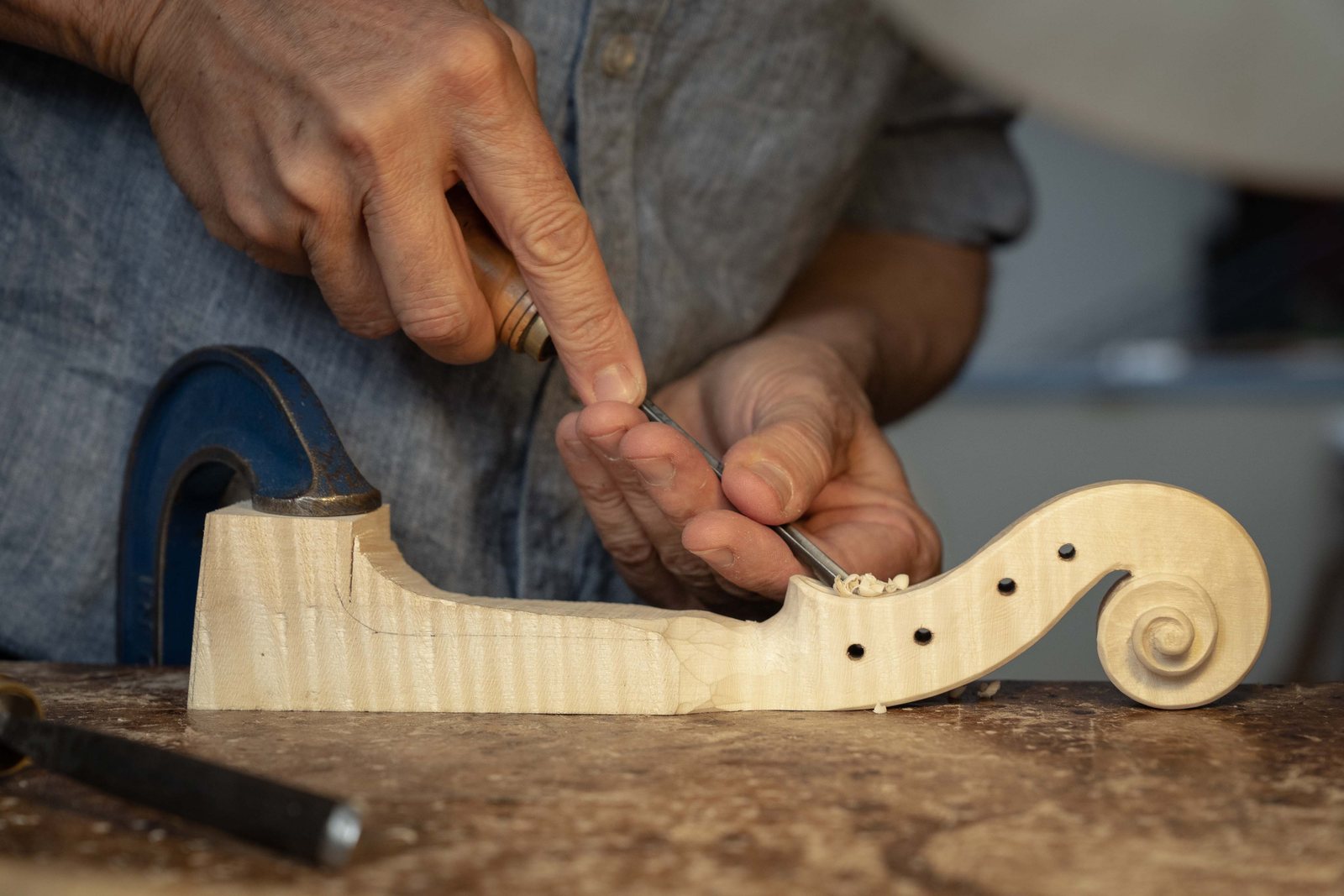
Frédéric ChaudièreYou find all sorts of traces on violins. Inside, you find dust, fabric fibres, the smell of perfume, of wax, of glue. Outside, you find the marks of fingernails, of the bow, of a beard where the chin sits, of a shoulder rest. Successive bridges hollow out the table under their feet, and you can read in the deformation of the arching whether the soundpost has been kept too tight. Those traces are the most visible marks — but there is also the sonic imprint of the music that has made the instrument vibrate. A violin that has never been used resists, and does not give itself up the way one that has been played a great deal does.
He did not spoil it. He simply moved it from poetry into evidence: perfume, wax, glue, a beard, a bridge slowly sinking into spruce. The memory is real. It is just made of ordinary things.
The Strings SocietyA spruce grows for two hundred years, is felled, dries for years, and only then becomes a violin that will play for three centuries. When you choose a piece of wood today, you are choosing it for someone who hasn't been born. Is that a thought that stands at the bench with you, or a Sunday thought?
Frédéric ChaudièreI make violins for the musicians who have commissioned them, of course — but it is above all for the object itself that I work. The violin has to outlive its owner, and to suit a very wide range of use. It has to be able to play jazz, or Mozart, or tango. It has to be able to sound in a small room, or outdoors, on a microphone.
On the drying, he wanted a precision added.
Frédéric ChaudièreThe wood I use can be thirty years old, but in general it is more like ten.
The Strings SocietyAnd does a violin die? If so — of what?
Frédéric ChaudièreThe wood ends up losing its elasticity, but over a very long span of time. Treated well, violins go on working after five centuries: some of the earliest violins, made by Andrea Amati in the 1560s, are still played today, on the stages of great halls.
And then there are violins that die along the way — woodworm, bad repairs, revolutions. The sack of the Tuileries, and the King's violins thrown out of the windows.
• • •
Two names carry the entire mythology of the violin, and a century of writing has been spent insisting that one is the geometer and the other the genius. We asked him to set the mythology aside for a minute.
The Strings SocietyWith a Stradivari on one bench and a del Gesù on the other, what do you see — with your own eyes and hands — that actually separates them?
Frédéric ChaudièreYou see at once that del Gesù worked fast, that he went straight to what was essential for the thing to sound — and that Stradivari, with his sense of detail, of symmetry, of control, had other priorities.
The Strings SocietyWith del Gesù, especially late, we talk about a hand in a hurry, f-holes that don't match, an irregularity we have gone so far as to call genius. Does that irregularity make the sound — or are we making it say what suits us?
Frédéric ChaudièreThe irregularities do not make the sound. But by working fast, you learn to anticipate, to guess the nature of the material. You have a different kind of control from the one that comes out of an obsession with detail.
That is a quiet demolition of an entire genre of programme note, and it repays reading twice. The crooked f-hole is not the cause of anything. What the speed produced was a different relationship with the material — a man who had to read the wood in front of him rather than impose a drawing onto it.
Which brings us to the room we shared.
The Strings SocietyA club whose purpose is to gather, once a year, instruments that spend the rest of the time in safes, and compare them by ear: what does a maker want from a room like that?
Frédéric ChaudièreMany of the violins shown at the Del Gesù Club are played in public by professional musicians all year round. Being able to hear them one after another teaches you a great deal. By comparing their architecture, you understand better why the instruments of the last period are more powerful, or darker.
The Strings SocietyWe were in Saanen for that first public evening. We heard beauty. What would you have been listening for?
Frédéric ChaudièreI was at that concert, and I enjoyed it a great deal. Some violins are more interesting than others; some have better highs, others are luminous in the low register. There are disappointments too — notes that roll, E strings that whistle.
We asked him what a disappointment is actually made of. How a violin worth more than a house fails to deliver, and whose fault it is.
If we are talking about sound, some precious violins are extraordinary, magical — and others are more ordinary, or even disappointing. The great moments in concert come from the conjunction of different factors: you need a magical violin, a brilliant performer, a generous acoustic and a wonderful score.
Four things, and only one of them is the violin. Everyone who has ever sat in a hall waiting to be moved and gone home unmoved has felt this without having a name for it. Here is the name, from a man who builds the first of the four: the instrument is one quarter of the evening. The rest is the player, the room, and the music itself — and any of them can withhold.
• • •
He spent months on the ‘Alard’ for the Musée de la musique. We wanted to know what months of copying teach that measurements cannot.
The Strings SocietyWhat did you learn in your hands that neither the eye nor the measurements would have given you?
Frédéric ChaudièreThere are things you cannot measure. The touch of a piece of wood is impossible to describe — and it is nonetheless essential. And there are details you can only observe when you have the violin in your hands.
The Strings SocietyWhere exactly does the line fall between a copy and a fake? In the intention, the label, the varnish, the silence of the man selling it?
The line is thin, but it exists. Sometimes very good copies are turned into fakes by unscrupulous dealers when they come back onto the market — and that is particularly hard to detect once they have acquired a fine patina of use.
Read that last sentence slowly, because it contains a small horror. The copy does not become a fake in the workshop. It becomes a fake decades later, in someone else's hands, once time has done the aging that no forger could. The maker is innocent and the object is guilty, and there is nothing he can do about it from here.
• • •
In 1936, a Stradivari of 1713 was stolen from Carnegie Hall. It stayed gone for nearly fifty years — played in secret, under another name, by the man who had taken it. It is known as the ‘Gibson’, and Frédéric Chaudière has written a book about it.
We asked why that one, and he answered in two sentences.
Frédéric ChaudièreThe 1713 ‘Gibson’ Stradivari was entrusted to me by Norbert Brainin, so that I could make him a copy of it. I found myself bound up in the story.
So we asked again, properly.
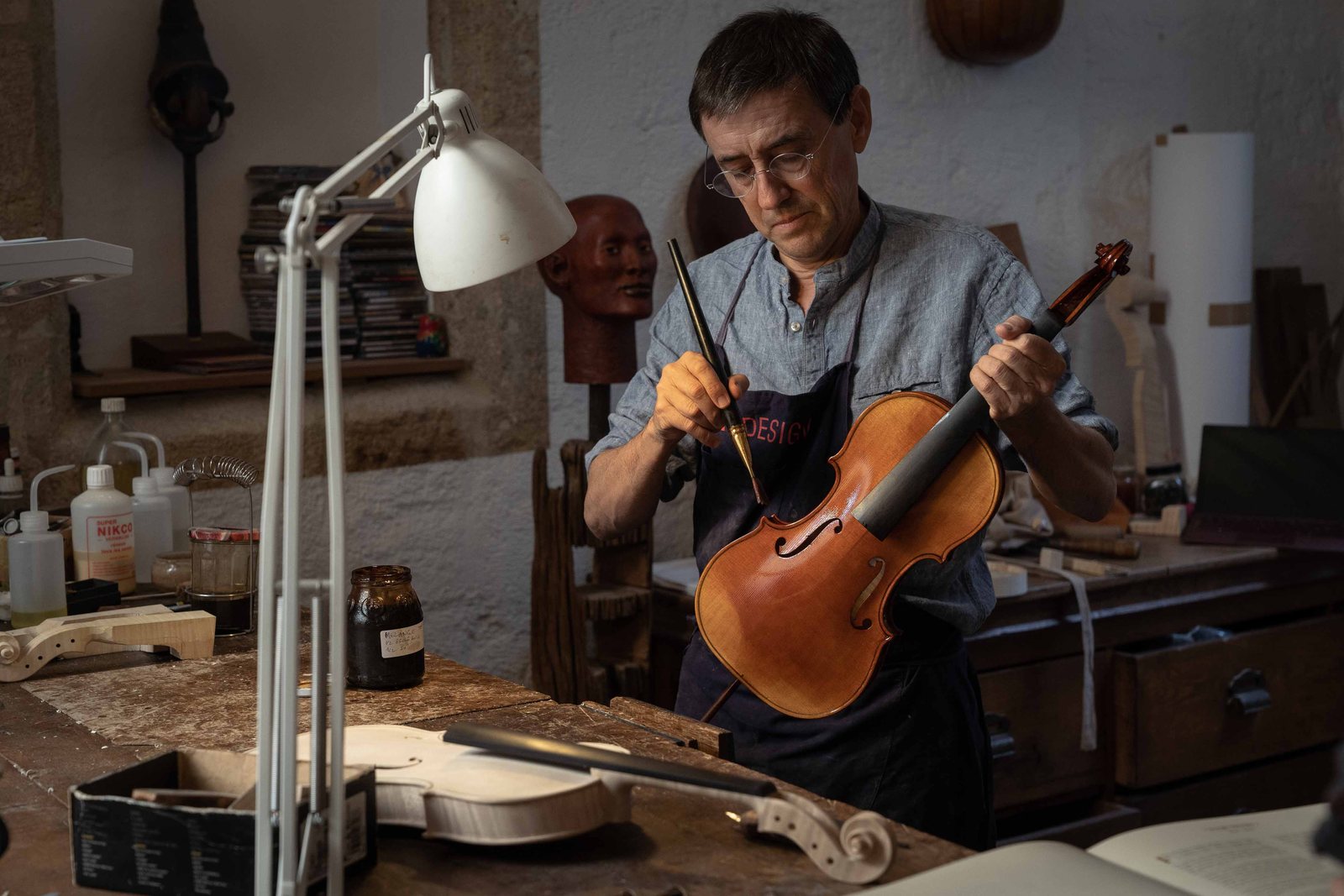
Frédéric ChaudièreBrainin had bought one of my violins before he acquired the Gibson. When he wanted to sell the Gibson, he asked me to make a fairly faithful copy of it. I had the Gibson in the workshop for six months, knowing all the while that the history of the violin was as important as the violin itself.
I was convinced that someone was going to take hold of that story and write it.
Ten years went by. And I woke up one night wondering whether the story had come out anywhere. I lay there a while, searching. In the end I got up, to begin writing it.
Two months later I sent the manuscript to Actes Sud, who published it straight away.
Sit with the shape of that. A violin that had been missing for half a century sits on his bench for six months while he copies it, and the whole time he is certain — not hopeful, certain — that someone will write this down. It is too good a story to go untold. Someone will do it.
Then ten years pass in which nobody does. And one night the thought arrives at the hour when thoughts arrive, and he lies in the dark going through everything he has read, looking for the book, and it isn't there. So he gets out of bed.
Two months. Then Actes Sud.
We asked him, separately, whether a hidden instrument ages differently from one that is shown.
Frédéric ChaudièreThe things we hide are highly significant, and violins that are hidden tend to age fast. The Gibson took a hard knock of age over its fifty years underground.
And on writing:
• • •
He is a court expert. Somebody walks in believing they hold a treasure — sometimes the only thing their father left them. It isn't one. We asked how you say that, and whether an expert is allowed to weigh what an attribution means to the person holding it, or whether weighing it is already the beginning of a lie.
Frédéric ChaudièreI tell clients the truth, and they do what they want with it.
It also happens that a client does hold a treasure, and that one of the greatest experts is wrong in telling them it is a copy.
That second sentence is the whole answer, and it points at a violin: the 1742 ‘Rovelli’ del Gesù, the subject of his own article in The Strad this June.
Frédéric ChaudièreThe Rovelli was correctly attributed, until a very important expert declared it a fake. I had to fight to re-establish the authenticity of that del Gesù.
He does not name the expert, and we did not ask. But notice what the story does to the shape of his job. The danger he describes is not the man who believes too much. It is the authority who says no — and is wrong, and is believed, because of who he is. An attribution can be taken away by reputation alone, and getting it back takes a fight.
The Rovelli itself was not at Saanen. It had been shown three years earlier, at the Del Gesù Club's Berlin gathering — a reminder of something easy to forget after the July concert: the club had been running for years before it was ever public, those violins already being compared with one another in private rooms, far from any stage. A violin a very great expert had declared a fake among them.
• • •
The Strings SocietyYou have made violins for players who had held the great old instruments. When a musician tries an instrument in your workshop, do you know before they do that it's the right one?
Frédéric ChaudièreYou get indications of a violin's sound quality at the moment you rough it out. There can be surprises, good and bad — but the verdict falls within a few seconds, when the musician puts the bow on the strings.
Months of work. Two hundred years of tree. A decade of drying. And a verdict in a few seconds.
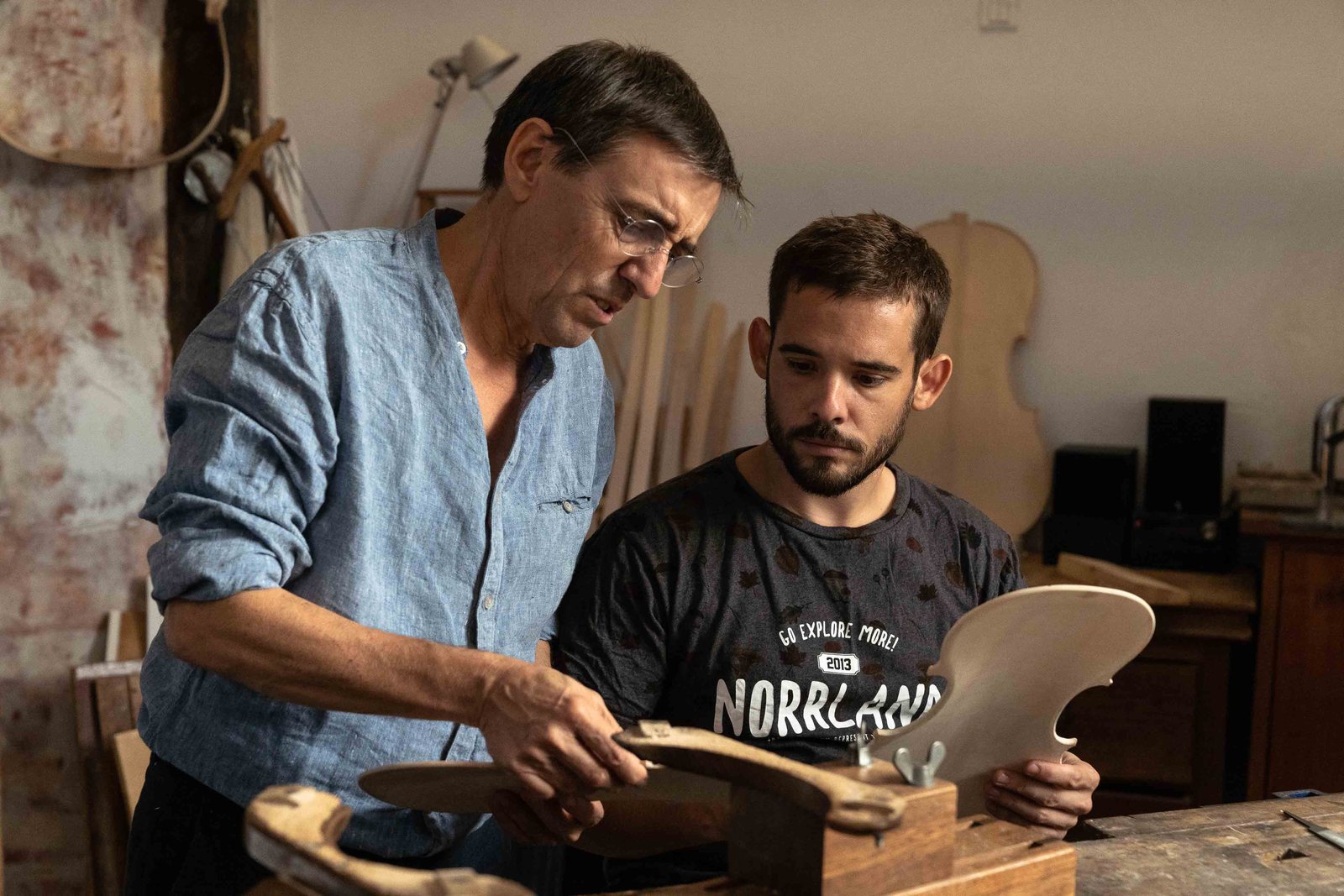
The Strings SocietyThe workshop has become a household: Lucie, Octave. In a craft of the hands, what actually transmits?
Frédéric ChaudièreTransmission happens through listening, through discussion, through observation. Sensitivity to touch, to smells, to volumes, to sounds is passed on slowly — and it is easier when you were born into that environment.
We end every conversation the same way: who should we talk to next, and what should we ask them? He sent us back into his own house.
Frédéric ChaudièreYou should talk to Octave about the making, to Lucie about communication and the running of the workshop, and to Adèle about sales.
So we will.
• • •
We came to Frédéric Chaudière expecting to be told that wood has a soul. Instead we were told that wood has dust in it, and fibres, and the smell of somebody's perfume; that the crooked f-hole is not the secret; that the violin is one quarter of a great evening; and that a copy is made to impress while a fake is made to deceive.
And then, at the end, the least practical thing a practical man ever admitted: that he lay awake one night ten years after a stolen violin left his bench, waiting for a story that nobody had written — and got up to write it himself.
The instruments outlive everyone who touches them. That is the whole trade, and he knows it better than anyone: he chooses wood for players who have not been born. But the stories don't outlive anyone automatically. Somebody has to get out of bed.
— S.
Interview conducted in writing, in French, August–September 2026, and published with his approval.
Photographs © Chaudière Violins, photo M. Mosconi.