Name That Film (and Its Villain)
I don't remember the first time I heard John Williams. Nobody does. He was simply there, in the dark of a cinema, long before I knew music had a name attached to it. He's in the moment the lights go down. In the jump in your seat, in the tears you didn't see coming, in the laugh. And he's still with you when you walk out into the street, humming.
John Williams, Hans Zimmer, Ennio Morricone, Nino Rota, Joe Hisaishi, Howard Shore. They're more than names, more than composers. They wrote the soundtrack of the films we loved, and somewhere along the way, of our lives too. They turned film music into a genre of its own, and one of the most loved anywhere. Their music walked out of the cinema a long time ago, and for millions of us it never left.
Think about it for a second. When you remember a film you love, what comes first: the scene, the faces, or the music? By now they're impossible to pull apart. A few notes bring back the whole scene, and a single frame arrives with its soundtrack already playing.
That's the magic these composers made. And it's why I wanted to celebrate John Williams and his new album, Legacy. He's 94, and he still has more energy than I do.
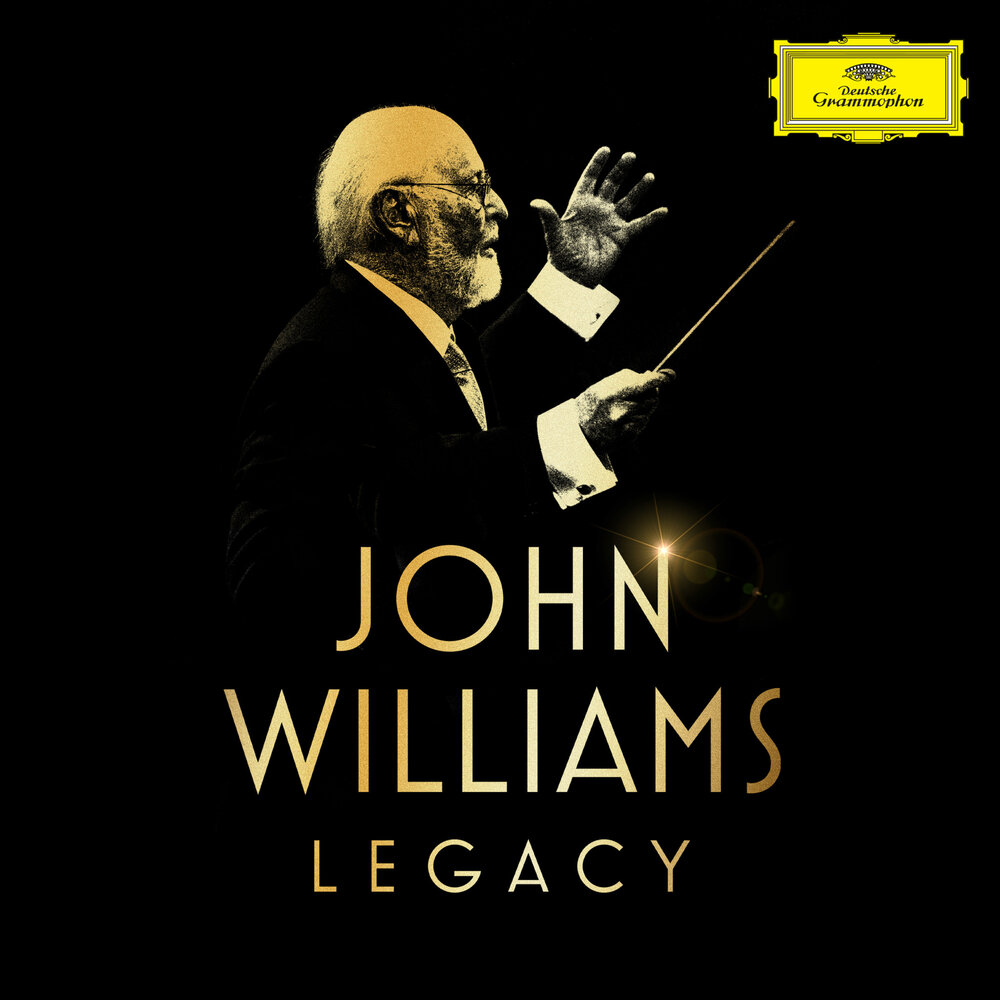
John Williams Legacy is Deutsche Grammophon's 15-track tribute to him. It isn't a set of new recordings. It gathers the best of what he conducted for the label at 87 and 89, with two orchestras he had never conducted before: the Vienna Philharmonic at the Musikverein in January 2020, and the Berlin Philharmonic at the Philharmonie in October 2021. One guest track comes from further back: Anne-Sophie Mutter's Schindler's List, from Across the Stars. The liner notes are by film music historian Jon Burlingame, and the album is out on CD, gold double vinyl and digital, including Dolby Atmos.
Most of us learned what an orchestra could do from him, long before we ever set foot in a concert hall: strings that soar, brass that makes your heart race, a single flute that makes you cry over an alien. He taught generations to listen, without ever asking us to.
But Halloween is coming, and every hero he ever scored needed someone to beat. Behind every theme you can hum there's a shadow: a helmet, a hook, a name nobody dares to say.
So let's play. Two rounds: guess the film, then find the villain.
Fifteen tracks. For each one, a clue: read it, hear the music in your head, and say the film out loud before you open the answer. Then look for the 🦇, which marks who's lurking in the dark of that film and what Williams does about it. No prizes, but you'll be humming for the rest of the day, and that's on him. And a bit on me ;)
A long time ago, somewhere very far from here, there's yellow writing crawling up into the stars. Then one chord hits you like a door slamming open.
Show the answerHide the answer
Star Wars: A New Hope — Main Title · Wiener Philharmoniker
The album opens the way the cinema did in 1977: with no warm-up. That brass fanfare is maybe the most famous first second in film music. Hearing it from the Vienna Philharmonic, in the hall of the New Year's Concert, is a small joke in itself. The Galactic Empire, meet the Habsburgs.
Minutes after this fanfare, a Star Destroyer slides over your head and won't stop coming, and a man in a black helmet steps through the smoke. Hold that thought. He comes back at track 12.
A glittering little tune on a toy-like keyboard. Something with feathers and white wings is carrying a letter you've waited eleven years for.
Show the answerHide the answer
Harry Potter and the Philosopher's Stone — Hedwig's Theme · Berliner Philharmoniker
It opens on a celesta, the bell-keyboard Tchaikovsky gave to the Sugar Plum Fairy. Williams wrote it before he'd seen a single frame of the film, for a promotional short, and first played it to director Chris Columbus on the piano. Columbus later called that “one of those great geek moments.”
Listen again and it isn't all sugar. The melody slides and twists in ways a lullaby never would, and that's the shiver in it: magic that might bite. Somewhere in this film, a face is hiding on the back of someone's head under a turban. He-Who-Must-Not-Be-Named is already in the music.
A hat. A whip. A rolling boulder. A man who really, really hates snakes.
Show the answerHide the answer
Raiders of the Lost Ark — Raiders March · Wiener Philharmoniker
Williams brought Spielberg two different tunes for Indiana Jones, so he could pick one. Spielberg wanted both. So the second became the middle section, and that's why the march suddenly turns lyrical halfway through before charging off again. Listen for the moment it changes: you're hearing a director who couldn't choose.
The villains are Nazis and a rival archaeologist in a white suit, and the scariest thing in the film is what's inside the box they're all chasing. Faces melt. Williams answers all of it with a march so cheerful it refuses to be afraid.
A bicycle basket. A blanket. A full moon. Five boys and one passenger who should not be on Earth — and then the wheels leave the ground.
Show the answerHide the answer
E.T. the Extra-Terrestrial — Flying Theme · Berliner Philharmoniker
Normally a composer fits the music to the film. Here it went the other way. While recording the final chase, Williams kept fighting the timings. Spielberg switched off the projector and told him to conduct it the way he felt it. Then he went back and re-edited the scenes around the music. Every time those bikes lift off, the picture is following the orchestra.
The monsters here are grown-ups: faceless men in spacesuits, a jangle of keys on a belt, roadblocks. E.T. is the scary one only for the first ten minutes. Williams decides who wins the chase, and he decides it in the sky.
A glass of water trembling on a dashboard. Then a helicopter over an island, and a gate that should probably have stayed shut.
Show the answerHide the answer
Jurassic Park — Theme · Wiener Philharmoniker
This is the one that isn't scary. Williams kept the roaring for the action cues and gave this theme to awe instead: slow, wide, almost a hymn. It's the music of the first time you see the creatures, before anyone starts running.
The real villain isn't the T. rex. It's a programmer who switches off the fences to smuggle out a few embryos in a can of shaving foam, and the dinosaurs only do what dinosaurs do. Williams writes the theme for the creatures and saves the fear for the humans' mistakes.
Glasses. A newsroom. A phone box. Then a red cape, and three notes that shoot straight up.
Show the answerHide the answer
Superman March · Berliner Philharmoniker
Listen to the very start of the melody: a short note, then a leap up, like someone taking off. It's 1978, and it's still the sound every superhero theme since has been measured against.
His enemy is Lex Luthor, a genius with a lair under Grand Central and a plan to sink California. For a hero this bright you need a villain who's enjoying himself, and the march never takes him seriously enough to sound worried.
A girl in a red coat, the only colour on a black-and-white screen.
Show the answerHide the answer
Schindler's List — Theme · Anne-Sophie Mutter, Recording Arts Orchestra of Los Angeles
This is the one track not from Vienna or Berlin, and the one track with a solo violin. It comes from Across the Stars (2019), the album of Williams arrangements he made with Anne-Sophie Mutter. In Vienna she stood beside him for much of the first half.
When Spielberg showed him the film, Williams told him: “You need a better composer than I am for this film.” Spielberg answered: “I know. But they're all dead.” The theme was first played by Itzhak Perlman. Here it is Mutter's.
No clue would have been right for this one, and no game. The evil in this film was real.
Five rings. Los Angeles, 1984. A trumpet call you've probably heard at a medal ceremony without knowing who wrote it.
Show the answerHide the answer
Olympic Fanfare and Theme · Berliner Philharmoniker
Written for the 1984 Summer Games, it's the most purely ceremonial piece on the album: brass announcing that something important is about to happen. Turn it up.
Villain: none. Unless you count whoever is in the next lane.
Five notes. A mountain sculpted out of mashed potatoes. A mothership the size of a city that answers back.
Show the answerHide the answer
Close Encounters of the Third Kind — Excerpts · Wiener Philharmoniker
Five notes are how humans and aliens say hello in this film. Williams reportedly wrote nearly 300 versions of that little phrase before Spielberg chose one. In these excerpts you'll hear them as the scientists play them and the ship replies: the first conversation with another world, and it's a duet.
This is the Halloween twist. The film is built like a horror story: lights in the night sky, a child taken from his home, toys switching themselves on. Williams writes the dread, and then he flips it. The things in the dark were friendly all along.
A boy who lives in a cupboard under the stairs walks through a brick wall into another world.
Show the answerHide the answer
Harry Potter and the Philosopher's Stone — Harry's Wondrous World · Berliner Philharmoniker
If Hedwig's Theme is the invitation, this is the arrival: the big, warm end-credits piece from the first film, where Williams lets the orchestra open up and the magic stops whispering.
By the time this plays, the stammering teacher with the turban has been unmasked, and the face on the back of his head has gone. For now. This is the sound of a boy who won round one.
A swamp. A crashed X-wing. A very small green teacher who talks backwards and lifts the whole thing out of the water.
Show the answerHide the answer
Star Wars: The Empire Strikes Back — Yoda's Theme · Berliner Philharmoniker
This is the gentlest Star Wars music Williams ever wrote: a melody that rises slowly and keeps rising, about wisdom rather than power. In Berlin, the strings take their time with it. Size matters not.
On this same swamp there's a cave. Luke goes in, a dark figure in a black helmet comes at him, and when the mask falls the face inside is his own. That's the scariest scene in the saga, and it's next door to this theme.
Black helmet. Heavy breathing. You know exactly who just walked onto the bridge.
Show the answerHide the answer
Star Wars: The Empire Strikes Back — The Imperial March · Wiener Philharmoniker
Here he is, the man from track 1. And here's the surprise: Darth Vader didn't have this music in the first film. It arrived in 1980, and it has been the official sound of villainy ever since. You know it from the first two notes, and so does every marching band, sports stadium and ringtone on Earth.
The best detail from Vienna: it wasn't on the original concert programme. The orchestra's brass players asked Williams in rehearsal if they could add it. One of the most traditional orchestras in the world asked to play the Dark Side.
The villain of the album. No contest. Play it loud on the 31st.
A grown-up who forgot how to be a boy. A pirate with a hook for a hand. Second star to the right, and straight on till morning.
Show the answerHide the answer
Hook — The Flight to Neverland · Wiener Philharmoniker
Hook reportedly started life as a musical, with songs by Leslie Bricusse, and traces of that are all over the score: Williams writes it like a show tune with a full orchestra behind it. This is the moment Peter remembers he can fly.
The villain is in the title. Captain James Hook, curled moustache, terrified of clocks, and he gets top billing. But this music is all on the boy's side, and by the time it soars, the pirate has already lost.
A hologram flickering out of a little droid: help me, you're my only hope.
Show the answerHide the answer
Star Wars: A New Hope — Princess Leia's Theme · Berliner Philharmoniker
This is a love theme for a princess who spends most of the film running the rescue herself. It's slow and tender, carried by a solo horn and then the woodwinds. Williams gives her the most romantic music in the saga, and she never needs it.
She's the one who stood up to them in person: Vader's interrogation droid and Grand Moff Tarkin, who blew up her home planet in front of her. She doesn't break. The tenderness here is hers, not theirs.
A hall full of rebels. Three heroes walking down a long aisle. Medals, a wookiee roaring, and a droid doing a little twirl.
Show the answerHide the answer
Star Wars: A New Hope — Throne Room & Finale · Berliner Philharmoniker
The album ends where the first film ended: with a celebration. The Throne Room march leads into the end-credits music, so you hear the Main Title from track 1 one more time, now as a farewell instead of an entrance.
The Death Star is dust. But a single TIE fighter was last seen spinning off into space, and you know exactly who was inside it. Villains like this never stay gone. Williams knew it too, and three years later he gave him track 12.
Two notes. Underwater. Getting closer.
Jaws isn't on this album. Of all the music John Williams ever wrote, the scariest piece didn't make the cut. Maybe that's for the best, if you're planning to swim this Halloween.
• • •
While writing this, I kept wondering whether John Williams ever plays the game I play. Walking down the street, or chatting with someone, I sometimes try to guess which of his themes starts playing in their head when they hear his name. The Imperial March? The flying bicycles? A little owl?
Almost everyone knows his name. And those who don't certainly know his music, even if they've never put the two together. That's an achievement few composers of our time can score.
So, your turn. When you hear “John Williams”, which one plays first?
John Williams Legacy · Deutsche Grammophon, 2026 · John Williams, conductor · Wiener Philharmoniker (Musikverein, Vienna, 18–19 Jan 2020), Berliner Philharmoniker (Philharmonie, Berlin, Oct 2021), Anne-Sophie Mutter and the Recording Arts Orchestra of Los Angeles (track 7, from Across the Stars) · Liner notes by Jon Burlingame · CD, 2LP gold vinyl, digital (also in Dolby Atmos).