The Voice You Think In
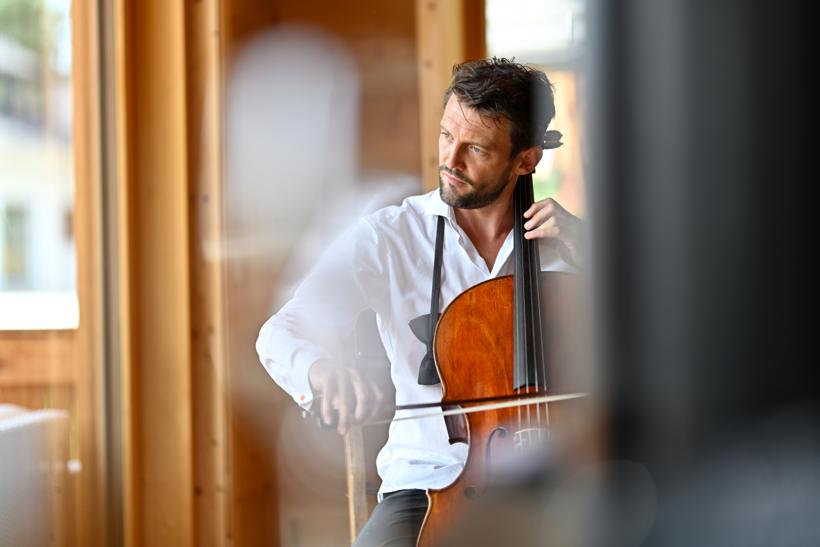
Truth is, when you feel something and it stays with you, you have to go for it. You have to give it room, nourish it, let it grow.
That’s what happened to me in Salzburg last year, at the KlangBlickMomente benefit concert in the Großer Saal of the International Mozarteum Foundation. And I still can’t shake that night.
Honest confession: I was there for David. But — and there’s always a but — I found myself pulled into something so deep and unexpected that I was completely blown away. Ask my partners in crime: I couldn’t speak for a long, long time after the concert. (And boy, can I speak. 😛) I couldn’t process what I’d just witnessed, and most of all I couldn’t contain the tide of emotion that hit me in that hall.
Why? you’d ask.
This is why. And it’s why I hope that if you’re reading this, you’ll do your best to get tickets for this year’s concert in September. Trust me — it will be worth it.
Every time you attend one of David’s classical concerts, you know something will happen to you. We know that feeling by now. But this time was different.
Maybe it was the romantic magic of Salzburg. Maybe the magnificent Mozarteum hall, all golds and whites. For sure it was the awareness of the cause — children fighting cancer and the families who never leave their side. The evening was already heavy with feeling before a single note was played.
But then, being there, it surpassed every expectation. Deep and painful. Elating and astounding. True. Devastating. Beautiful.
And all of this happened to me before David even walked on stage.
An artist I knew of, but had never heard live, made his way to the front. A commanding figure — yet a face and a smile that undid me on sight. A Stradivarius cello in his hands, and a voice that carried emotion and composure at once.
Emanuel Graf was in front of me.
I was thrilled to finally hear him play live — but I wasn’t ready for what came next. Introducing The Swan from Saint-Saëns’ Carnival of the Animals, Emanuel shared a story with the audience. I won’t repeat it here — forgive me. Let’s just say it was bound, terribly, to the reason we were all there that night: a little girl, a struggle, and an ending no one should ever have to bear.
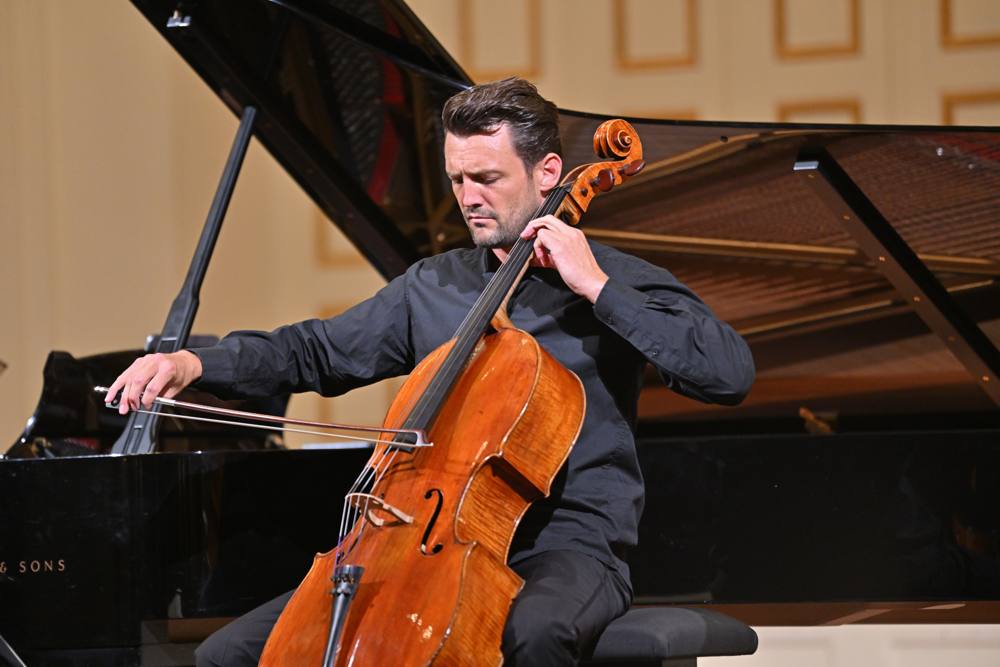
That story, and the slight tremble in his voice before he’d even begun to play — something shifted. It changed everything for me. I forgot the spectacle and let myself be drawn into the emotion of the moment. It gave such tangible meaning to everything that followed that, even now, I can say without flinching: Salzburg was the most moving concert of my life. (And I’ve been to many!)
The whole audience was in tears. I watched grown men in their suits unable to hold it together. And when the piece ended on a flourish of Emanuel’s bow — after a silence that seemed to stretch forever — the hall erupted into a roaring, standing ovation. It felt like a release. A lifting of that beautiful, painful something Emanuel had passed to us, straight from his hands to our throats.
So this is why we’re here.
Because I could never forget that feeling, that moment, that night. Or Emanuel Graf.
I reached out and asked if he’d be open to an interview — he’s back on stage this September 12th for the 2026 edition of the KlangBlickMomente benefit concert in Salzburg (we talked about it here).
And he said yes.
Here’s the full interview. Warm, fun, insightful. A glimpse of Emanuel that he kindly shared with us with that natural touch I came to love.
And between you and me… this man must be remarkable. Deep, yet grounded. Sharp, yet kind. And fun. A real gem. 😊
I’m so glad we managed to bring this one home. Thank you, Emanuel — thank you, so very much, for letting us know you better, in your own words.
• • •
The Strings SocietyWhen the concert hall suddenly falls completely silent — when you can feel the entire room holding its breath — what is actually happening for you in that moment? Do you sense it while you’re playing, or only afterwards?
Emanuel GrafI love that silence. This incredible, collective concentration of hundreds of people, all focused on a single point at the same time — that’s an energy you can almost feel physically. It feels like a quiet hum in the air. While I’m playing, I’m already aware of it, but I don’t think about it. It carries me. It’s as if the hall is breathing with me. Only afterwards, when the last note has faded and there’s still that tiny moment of absolute silence before the applause breaks out — in that fraction of a second I truly realise what just happened. Then comes that quiet “Wow… that was special.” Sometimes I think: we just created something together that was bigger than the sum of everyone in the room. That’s one of the most beautiful moments our profession has to offer.
The Strings SocietyWhen did the cello stop being just an instrument you played and become the voice you think in? Was there a single moment, or did it happen gradually?
Emanuel GrafIt came gradually — like most really important things in life. At the beginning, it’s simply about getting a decent sound out of this awkward box. You fight with intonation, with the bow, with your body. Then, very slowly, something changes. The singing tone becomes a lifelong task. And suddenly you realise: the cello is no longer something you operate — it becomes the voice you think in. What’s particularly fascinating is how you hear yourself. Often it’s already singing inside me long before the first note sounds in the hall. The audible reality is then usually just the translation of what I’ve already clearly heard inside myself. And I’m convinced: the best school for any instrumentalist is to experience great singers live. They show us what real vocal art is — that natural, breathing line, that direct connection between emotion and sound. I still try to bring that into my playing every single day.
The Strings SocietyThe Swan is one of the most-played pieces in the world. How do you find your own Swan each time — what are you searching for that the listener might not even consciously notice? And is there a difference for you between a piece that dazzles a room and one that quietly undoes it?
Emanuel GrafOh yes, absolutely! There are pieces that fascinate — and there are pieces that touch. The Swan clearly belongs in the second category for me. Every time I play it, I’m looking for that very special mixture of majestic poise and great inner vulnerability. The outer clarity and beauty of the line must be there — but underneath, something should quietly vibrate, a kind of silent weeping that you feel more than hear. These are often tiny details: a barely noticeable hesitation, a slight colouring of the tone, a breath that lasts a fraction of a second longer. Things the listener may not consciously name, but which hit them right in the chest. Especially with pieces you play very often, the real art lies in moving further and further away from your own ego. Not louder, faster or more sentimental — but deeper. Calmer. More honest.
The Strings SocietySince 2022 you have been playing “L’Évêque de La Rochelle,” a Stradivarius from 1690. What did it feel like the first time you drew a sound from an instrument that already carries more than three centuries of life inside it?
Emanuel GrafIt will remain a moment in my life that I will never forget. It was love at first sound.
The Strings SocietyDo you feel that you play the instrument — or that you are in conversation with it? Does it demand something from you in return — and how would you describe its voice to someone who will only ever hear it through a recording?
Emanuel GrafBoth. I play it, and at the same time I have a dialogue with it. With an instrument like my Stradivari, you are incredibly inspired as a musician. The enormous overtone spectrum alone opens doors to sound worlds you simply don’t reach with a younger instrument. It literally forces me to think more finely — about articulation, about the connection between notes, about the tiniest colour nuances. The cello demands absolute presence and honesty from me. If I’m only “playing” and not really listening, it immediately punishes me with a flat or rebellious tone. Its voice? It is dark, warm and noble, with incredible depth and a very special, slightly smoky timbre. You can almost hear 340 years of history in it — but at the same time something very alive, almost human. Not a smooth, perfect sound, but one with character, with soul, and with a few very fine scratches that make it truly alive. Sometimes I have the feeling the cello is saying to me: “You may lead today, but never forget that I’ve been here much longer than you.”
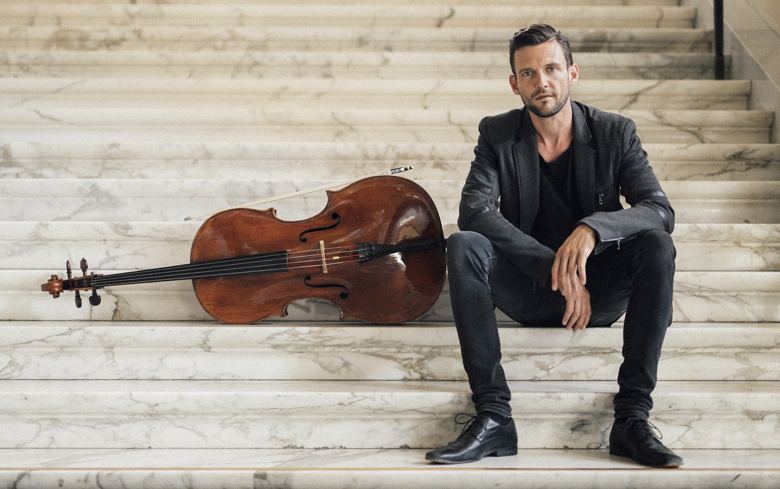
The Strings SocietyWhat we find rare about you is that you don’t only perform — you also build. Together with your family you founded the 3Klang Cultural Centre near Freiburg, where music meets literature, dance and painting. What was missing for you in ordinary concert life that made you want to create a place of your own?
Emanuel GrafIn my family everyone is crazy about music: both my parents are cellists, my sister is a fantastic violinist. Music was never just “work” at home — it was always the centre of life. The real impulse for 3Klang came above all from my mother, Barbara Graf. She had this strong inner drive to create a place where the different arts really come together — not just take place side by side, but genuinely fertilise each other. What I often missed in normal concert life was exactly that: real encounter. You play your concert, receive applause, and drive home again. Everything is very beautiful, very professional — and yet somehow sterile. I missed the space in which conversations continue after the last note, in which a poet and a dancer can talk with musicians, in which painting and sound can inspire each other. 3Klang is our attempt to create exactly that space: alive, curious, and a little chaotic — just like real life.
The Strings SocietyAnd Cellifamily — twelve cellists from all over the world. What do twelve cellos in one room give you that nothing else can? And what draws you to lifting up other players rather than only performing yourself?
Emanuel GrafCellifamily is something very special to me. Twelve cellos in one room create a sound you won’t find anywhere else — a huge, warm, almost symphonic carpet that remains incredibly intimate at the same time. It’s like diving into a collective heartbeat. You don’t just hear yourself, you immediately feel how your own tone merges with the others. That’s musically enriching, but also deeply human. What draws me most is passing things on. It has always been a great need of mine to pass my experiences and insights to younger cellists. Perhaps that comes from the family — the name “Cellifamily” is, by the way, programmatic: at one point there were seven professional cellists living in our house at the same time. You learn early that music is at its most beautiful when you share it. Standing alone on stage is wonderful, but in the long run it’s a bit selfish. Helping others find their own path and their own sound makes me at least as happy.
The Strings SocietyYou have premiered brand-new works, including pieces by Georg Friedrich Haas. What is it like to be the very first voice a new piece of music ever has — no recording, no tradition, nothing to lean on, only you and the page?
Emanuel GrafIt’s pure adventure, with a touch of panic. You suddenly become a co-creator. There is no “correct” interpretation — you have to invent it first. That is both liberating and a great responsibility at the same time. You feel: this piece will always carry a little bit of me in it.
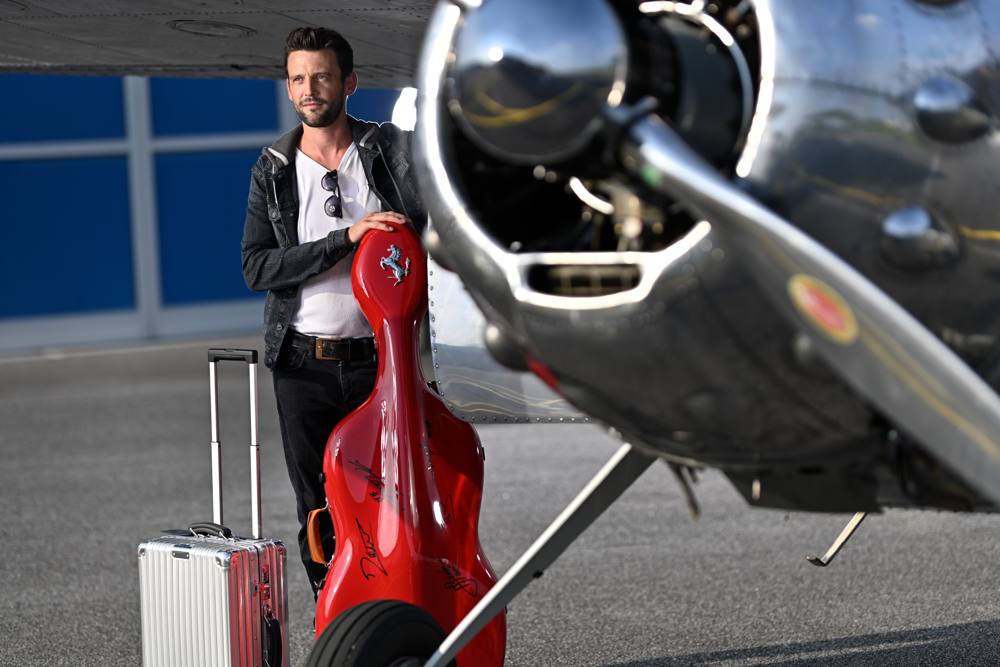
The Strings SocietyNow the question that will make us both beam and flinch — because The Strings Society writes to you from Italy, and our founder is, by her own cheerful admission, a lifelong Ferrari fan. You play a Cremonese Stradivarius and carry it in a Rosso Corsa case. Where do the cello and the Ferrari secretly meet for you? You once compared a high-revving engine to a soprano soaring into the high notes — does music ever feel that physical to you?
Emanuel GrafHaha, finally we’re getting to the best part! 😄 Cello and Ferrari meet for me at a very personal point. As a child I actually wanted to become a racing driver. I watched Formula 1 for hours and imagined sitting in the cockpit myself. Later I discovered the cello — and somehow both have stayed alive in me. In the article with Ben Barry in Maranello it suddenly became very real: my Stradivari next to a Ferrari 250 LM, the engine running, the tones mixing together. That’s why my Rosso Corsa case is no coincidence, but a small piece of childhood dream that travels with me. The high-revving engine has, for me, exactly the same tension and beauty as a soprano soaring freely into the heights. And yes — music feels very physical to me. After some concerts I’m just as exhausted and euphoric as I used to be after a fast go-kart session. It’s the same mixture of control, surrender, and that beautiful feeling that technique suddenly turns into emotion.
The Strings SocietyAnd, one believer to another: loving the Scuderia through thick and (lately, very) thin has been something of an act of faith, hasn’t it?
Emanuel GrafAbsolutely! And how! 😄 I’ve become really closely connected with Ferrari by now — so it really hurts when things don’t go the way they should. You suffer with them, you swear, you hope… classic Ferrari relationship. But in the last two races we finally saw a really strong performance again — and most recently even a win! That felt like redemption. Somehow I’ve never met anyone who isn’t at least a little bit of a Ferrari fan. Even the most die-hard Mercedes or Red Bull supporters usually have a secret soft spot for the Scuderia. It’s simply that Italian mixture of drama, beauty and hope — that’s what connects people.
The Strings SocietyIf a young cellist wrote to you — unsure, hopeful, a little in love with the instrument — what is the one thing you would want them to know?
Emanuel GrafPlay true. Everything else comes with time. Technique, security, the big career — those are things you can work on. But this inner honesty, this willingness to really give something of yourself, you have to train and protect from the very beginning. Stay in love with your instrument — especially on the days when it feels like a stubborn donkey. Particularly then. Because that love is the only thing that will carry you through the many hours in the practice room and through the inevitable setbacks. And look for people with whom you make music, not just people with whom you make a career. The real moments almost always arise in encounters, not in competitions. In short: technique is important, but it’s only the boat. Love and truth are the sail.
The Strings SocietyAnd the smallest question of all: at the end of a long day, when you simply want to listen rather than analyse a single note — what do you put on?
Emanuel GrafAfter really long days I usually don’t listen to any music at all. My brain and my ears are simply full. The most beautiful “music” is then often silence — or the quiet snoring of my children next door. Otherwise I’m very open to all styles. Sometimes Keith Jarrett, sometimes Bill Evans, sometimes Italian pop from the 80s, sometimes an audiobook, or even just rain and sea sounds. As long as it relaxes and demands nothing from me. No analysis, no judgement — just enjoying.
• • •
Emanuel will be in Salzburg again, with David. And we will be there too — hands ready to clap, eyes ready to witness, souls open to be disrupted again, in the best possible way. From their hands to our throats.
Get your tickets here →