Music to Be Afraid Of: 13 Pieces for Halloween
Every year on 31 October the same handful of tunes comes out of the cupboard with the plastic skeletons. You know them even if you don't know their names: the organ that announces the mad scientist, the violins that scream in the shower, the xylophone made of bones.
None of them was written for Halloween. Most were written by respectable people in tailcoats, for concert halls, long before anyone carved a pumpkin on film. One frightened its first audience. One was never performed while its composer was alive.
And while we were putting this list together, we kept running into the same figure: the Devil, or Death, with a violin under his chin. He tunes it wrong. He steals it. He plays it better than any human ever could. He plays it in a dream, at a village wedding, in a graveyard at midnight. Somewhere along the way the violin became his instrument, and he never once seems to have picked up a flute. ;)
For the five people at the back who are wondering what Halloween actually is: it's 31 October, the eve of All Saints' Day. All Hallows' Eve, squashed down over the centuries into Halloween. Its oldest roots go back to the Celtic festival of Samhain, at the end of the harvest, when the wall between the living and the dead was said to be at its thinnest. Irish and Scottish emigrants took their customs to America, where the carved turnips became pumpkins (much easier to carve, if you've ever tried a turnip). Then came the costumes, the sweets, and children ringing doorbells with a threat: trick or treat.
So yes, the way most of us celebrate it, Halloween comes to us from America, and these days it turns up everywhere from Rome to Rio. We're not going to argue about what it should or shouldn't mean. Tonight we just want to have some fun with it.
So, thirteen pieces, counted down to midnight. For each one: what to listen for, where you've already heard it, and what the strings are up to. Lights down. Screams up! 🎃
In the Hall of the Mountain King
We start in the mountains, with something you could almost play at a children's party. Almost.
Peer Gynt has wandered into the hall of the troll king, and he has wronged the king's daughter. The trolls crowd around him. They want him dead.
Grieg couldn't stand it. He wrote that the piece "reeks of cowpats, ultra-Norwegianism and to-thyself-be-enough-ness", and that he couldn't bear to hear it. It became the most famous thing he ever wrote.
Listen for: a little tune that starts low, quiet and on tiptoe, then comes round again and again, faster and louder each time, until the whole orchestra is stampeding.
You've heard it in: Fritz Lang's M (1931), where a child murderer whistles it every time the urge takes him. Peter Lorre, who played him, couldn't whistle. The whistling you hear is Lang's.
🎻 Follow the strings as the tempo climbs. By the end they've stopped tiptoeing and started stamping.
The Soldier's Tale
A soldier on leave stops by a stream and plays his violin. An old man asks to buy it. It's the Devil, and he offers a book that promises wealth in exchange. The soldier makes the trade and spends what he thinks are three days at the Devil's house. When he gets home, three years have gone by and his village takes him for a ghost.
When he finally gets his violin back, it makes no sound.
It was first performed on 28 September 1918 in Lausanne, by three actors, a dancer and just seven musicians.
Listen for: the very last music in the piece. It's called The Devil's Triumphant March, and that tells you how the story ends.
🎻 There's only one violin in the band, and it's the soldier's. It's the one thing the Devil wants, and once he's touched it, it falls silent.
Symphony No. 4, second movement
In 1872 the painter Arnold Böcklin painted himself at work with a skeleton at his shoulder, playing the fiddle into his ear. According to Alma Mahler, that painting is where this movement began.
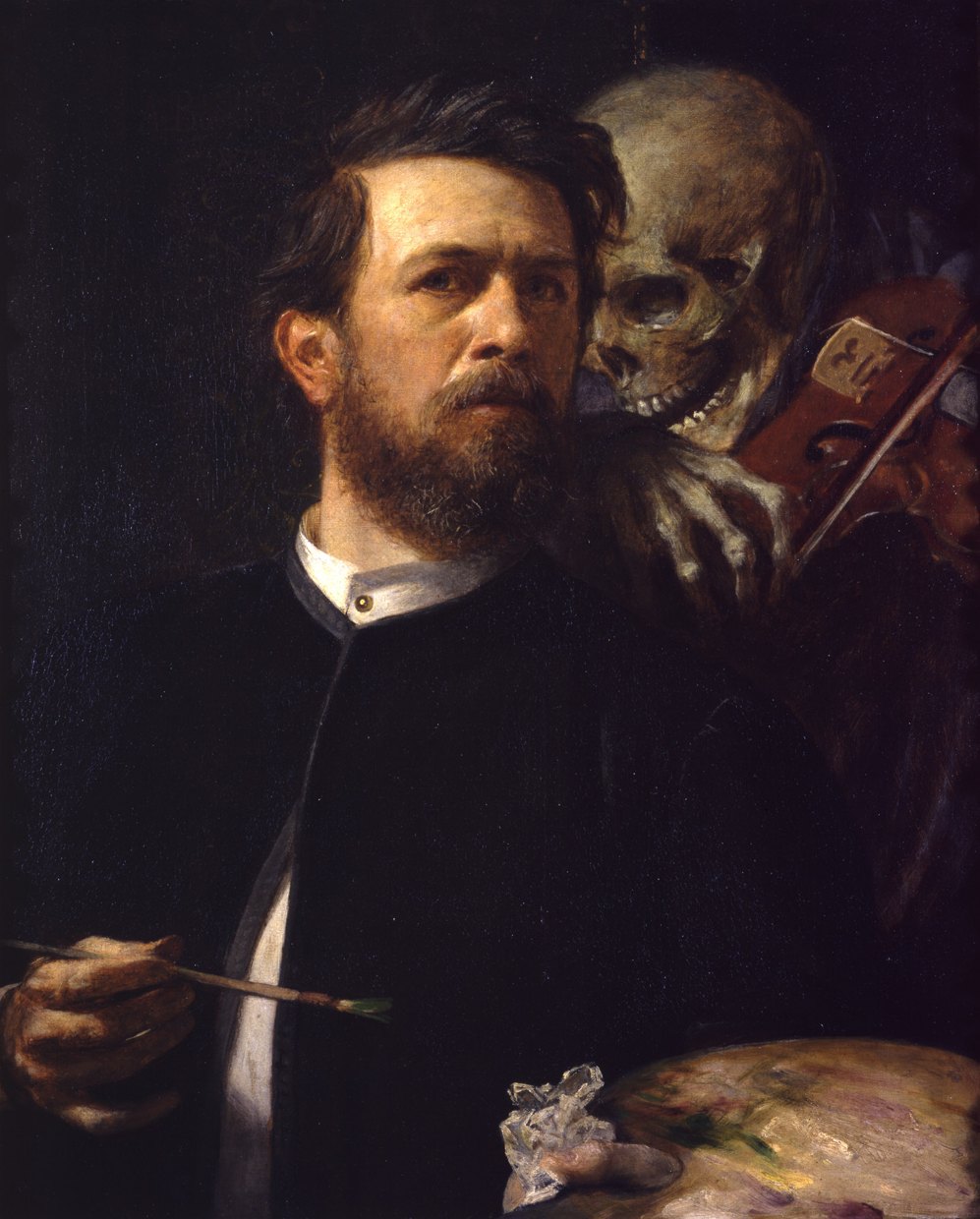
Mahler's working title was Freund Hein spielt auf: Friend Hein strikes up. In German folk tales, Freund Hein is Death. Here he's the village fiddler.
Listen for: a solo violin that sounds slightly off, scratchy and sour against the rest of the orchestra, like a fiddler at a country dance. Around it the orchestra stays sweet and gentle, and somehow that makes it worse.
🎻 Mahler's score asks the leader of the violins to put down their own instrument and pick up a second one, tuned differently. The fingers play the usual notes and the sound comes out harsh. That's Death's fiddle.
Mephisto Waltz No. 1
A village inn, and a wedding in full swing. Mephistopheles drags Faust inside, snatches the fiddle from a sleepy village fiddler and starts to play. Everyone dances. Faust whirls off with a village girl, out of the door and into the woods, while the fiddle fades and a nightingale sings.
The scene comes from Nikolaus Lenau's Faust (Lenau's, not Goethe's). Liszt wrote it for orchestra and, separately, for piano. The piano version is the one pianists still treat as a dare.
We told Liszt's story two weeks ago in The First Rock Star. He couldn't keep away from the Devil, and he'll be back at number 1.
Listen for: the opening, which sounds like someone tuning a fiddle, string by string, before he lets rip.
🎻 The Devil doesn't bring his own instrument. He takes the village fiddler's, just as he took the soldier's at number 12.
Threnody to the Victims of Hiroshima
Fifty-two string players: 24 violins, 10 violas, 10 cellos and 8 double basses. Penderecki first named the piece after its length, 8'37". Then he gave it the title it has today.
There's no tune to hum. The players bow behind the bridge and on the tailpiece, where a string instrument isn't supposed to make any sound at all, and they slap their instruments. What comes out is a wall of buzzing, swarming, screaming sound. You'd never guess it was violins.
You've heard it in: Alfonso Cuarón's Children of Men (2006), and in the eighth episode of the third season of Twin Peaks (2017), over a nuclear explosion. Penderecki's music also runs all through Kubrick's The Shining, and his Polymorphia is in The Exorcist.
🎻 Everything you thought a violin could sound like, turned inside out.
This is the one entry on the list that isn't a game. Its title asks you to remember what it was written for.
Psycho
Hitchcock made Psycho on a small budget, in black and white, with the crew from his television series. Herrmann wrote the score for strings only: no brass, no percussion, no woodwind.
Hitchcock wanted the shower scene to play without any music. Then he heard what Herrmann had written for it and changed his mind. He's quoted as saying: "Thirty-three percent of the effect of Psycho was due to the music." Herrmann was reportedly paid twice his usual fee.
Listen for: the shower. You know it already: the same high notes, stabbed over and over.
You've heard it in: Psycho, and in just about every parody of it since.
🎻 Those shrieks aren't birds, or electronics, or voices. They're violins, bowed hard and high.
The Devil's Trill
By Tartini's own account, one night in 1713 he dreamed he had made a pact with the Devil, and the Devil had become his servant. He handed the Devil his violin to see what he could do. The Devil played a sonata so beautiful that Tartini woke up overwhelmed and tried to write it down.
What he managed, he said, was "so inferior to what I had heard".
He told the story to the French astronomer Jérôme Lalande, who put it in his book of Italian travels. Scholars think the sonata itself was probably written much later, perhaps as late as the 1740s. It wasn't published until 1798 or 1799, almost thirty years after Tartini's death.
David Garrett recorded it on Garrett vs. Paganini (2013), an album about the violinist who comes next on this list. Tartini's dream came first.
Listen for: the trill in the last movement. One finger trembles fast on a single note while the other fingers play a melody at the same time. It's devilishly hard. That's the point.
🎻 This time the Devil doesn't steal the violin. Tartini hands it to him, and the Devil plays it better than its owner ever could.
Night on Bald Mountain
St John's Eve, 23 June 1867: the night the witches gather. That's the night Mussorgsky finished his piece about witches gathering on a bare mountain.
Then nobody would play it. His mentor, Balakirev, refused, and Mussorgsky never heard it performed in any form. Five years after Mussorgsky's death, his friend Rimsky-Korsakov rewrote it and conducted it in St Petersburg on 15 October 1886. That's the version the world fell for. Mussorgsky's own version wasn't published until 1968.
You've heard it in: Disney's Fantasia (1940), in Leopold Stokowski's arrangement. A demon called Chernabog unfolds his wings on top of a mountain and calls the dead out of their graves.
Listen for: the end. After all the shrieking, a church bell rings, dawn comes, and the music goes quiet and soft.
🎻 The strings open the piece as a rushing wind, and they keep the witches in the air.
Dream of a Witches' Sabbath
Paris, 11 September 1827. Hector Berlioz, twenty-three, watches the Irish actress Harriet Smithson play Ophelia and falls in love on the spot. She won't meet him. His letters go unanswered.
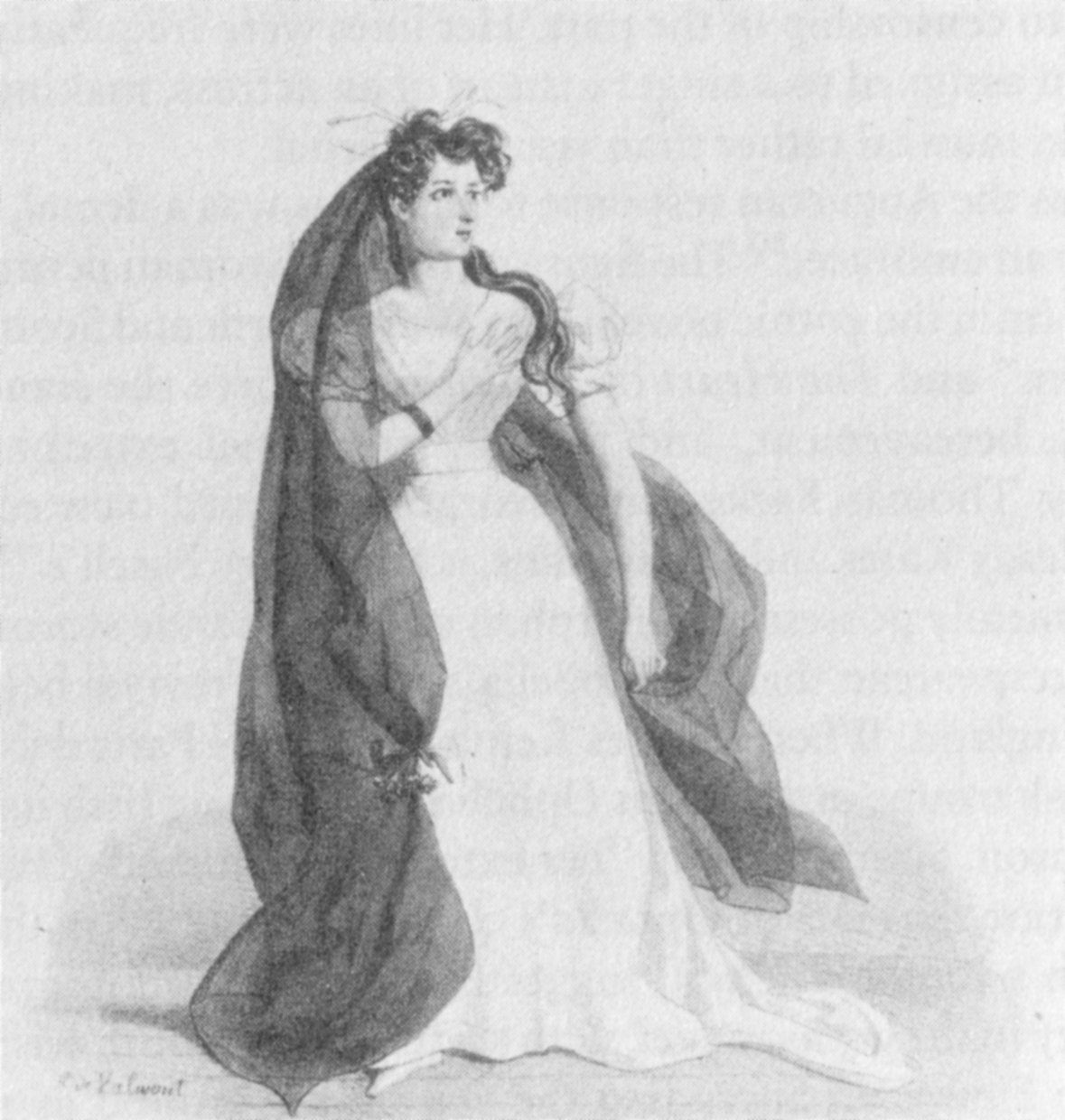
So he writes a symphony about it. In the story he printed for the audience, a young artist poisons himself with opium. The dose is too small to kill him, and he sinks into a sleep full of visions. In the last one he's at a witches' sabbath, among ghosts, sorcerers and monsters gathered for his funeral. His beloved is there too. The melody that has stood for her all through the symphony comes back cheap and shrill, as a squeaky dance tune on a small clarinet.
It was first performed on 5 December 1830, at the Paris Conservatoire. Harriet heard it two years later, and the year after that they married. How that went is another story.
Listen for: the bells, and then the deep brass and bassoons intoning the Dies irae, the medieval chant for the Day of Judgement. Remember it. It comes back twice more on this list.
You've heard it in: the opening titles of The Shining, where Wendy Carlos and Rachel Elkind built their main theme on that same chant.
🎻 Col legno: the string players turn their bows over and strike the strings with the wood. That's the sound of bones rattling.
Death and the Maiden
In 1817 Schubert set a short poem by Matthias Claudius as a song. A girl begs Death to pass her by, because she's too young. Death answers softly: give me your hand, I'm a friend, I haven't come to punish you, you'll sleep gently in my arms.
Seven years later Schubert took the song's piano part, the quiet, slow chords that belong to Death, and made it the theme of the second movement of a string quartet.
Listen for: the start of that second movement: slow, hushed, almost a hymn, like footsteps. Then the variations, where the violins grow more and more restless around it.
You've heard it in: its title, which went on to a play and a film, both called Death and the Maiden.
🎻 No devil, no fiddler, no tricks this time. Just four string players and Death's voice. What scares you is how kind he sounds.
Toccata and Fugue in D minor
A shiver of notes, a pause, then a crash: the mad scientist is in his laboratory.
But we're not even sure Bach wrote it. No copy in his hand survives. The only near-contemporary source is a copy by an organist called Johannes Ringk. In 1981 the English musicologist Peter Williams suggested that it may first have been written for solo violin, not necessarily by Bach, and arranged for organ later, again not necessarily by Bach. Violinists including Andrew Manze have since played it on the violin. Others, including the Bach scholar Christoph Wolff, believe it's Bach's own.
It was first printed in 1833, in an edition Felix Mendelssohn helped prepare, and Mendelssohn gave its first big public performance, in Leipzig in 1840.
You've heard it in: Dr. Jekyll and Mr. Hyde (1931), one of the first sound films to use it, and The Black Cat (1934). Captain Nemo plays it on the Nautilus's organ before an attack in 20,000 Leagues Under the Sea (1954). And Disney's Fantasia (1940) opens with Stokowski's version for orchestra.
Listen for: the opening flourish, and the huge dark chord that builds up from the bottom of the organ.
🎻 In 2010 David Garrett swapped the organ for an orchestra and a bass guitar, on Rock Symphonies. If Peter Williams is right, the Toccata was finally back on the violin.
Caprice 24
Born in Genoa on 27 October 1782. People called him the Devil's violinist, and he was the one person on this list that audiences were actually afraid of.
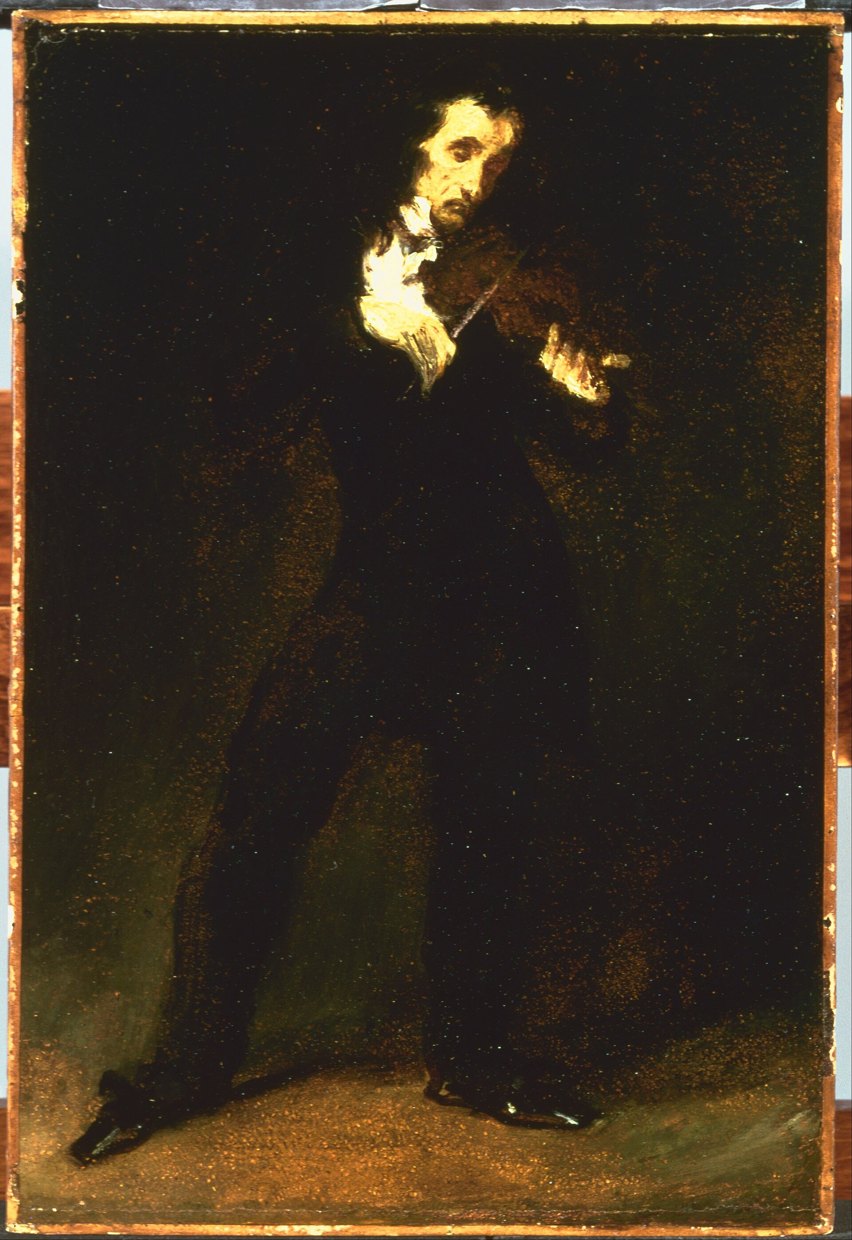
He had the fastest hands anyone had ever seen, and wherever he went a whisper followed him: nobody plays like that without a deal down below. Paganini fed the rumour, or at least he never starved it.
In 1840 it caught up with him. He died in Nice on 27 May, having refused the last rites, and the Church refused him a Christian burial. It was thirty-six years before he was laid in a proper grave, in Parma, in 1876.
In 1832 a young pianist went to hear him and walked out wanting to do on the piano what Paganini did on the violin. His name was Franz Liszt.
Listen for: a short, cheeky theme, then variation after variation, each one a new trick. In one, the left hand, which is busy pressing the strings down, plucks them as well.
You've heard it in: Rachmaninoff's Rhapsody on a Theme of Paganini (1934), built on this very tune. Partway through, the piano slips in the Dies irae, the chant from number 5.
🎻 His violin was a Guarneri he called il Cannone, "my cannon". He left it to Genoa. It's still there in the town hall, taken out and played now and then so it doesn't fall asleep.
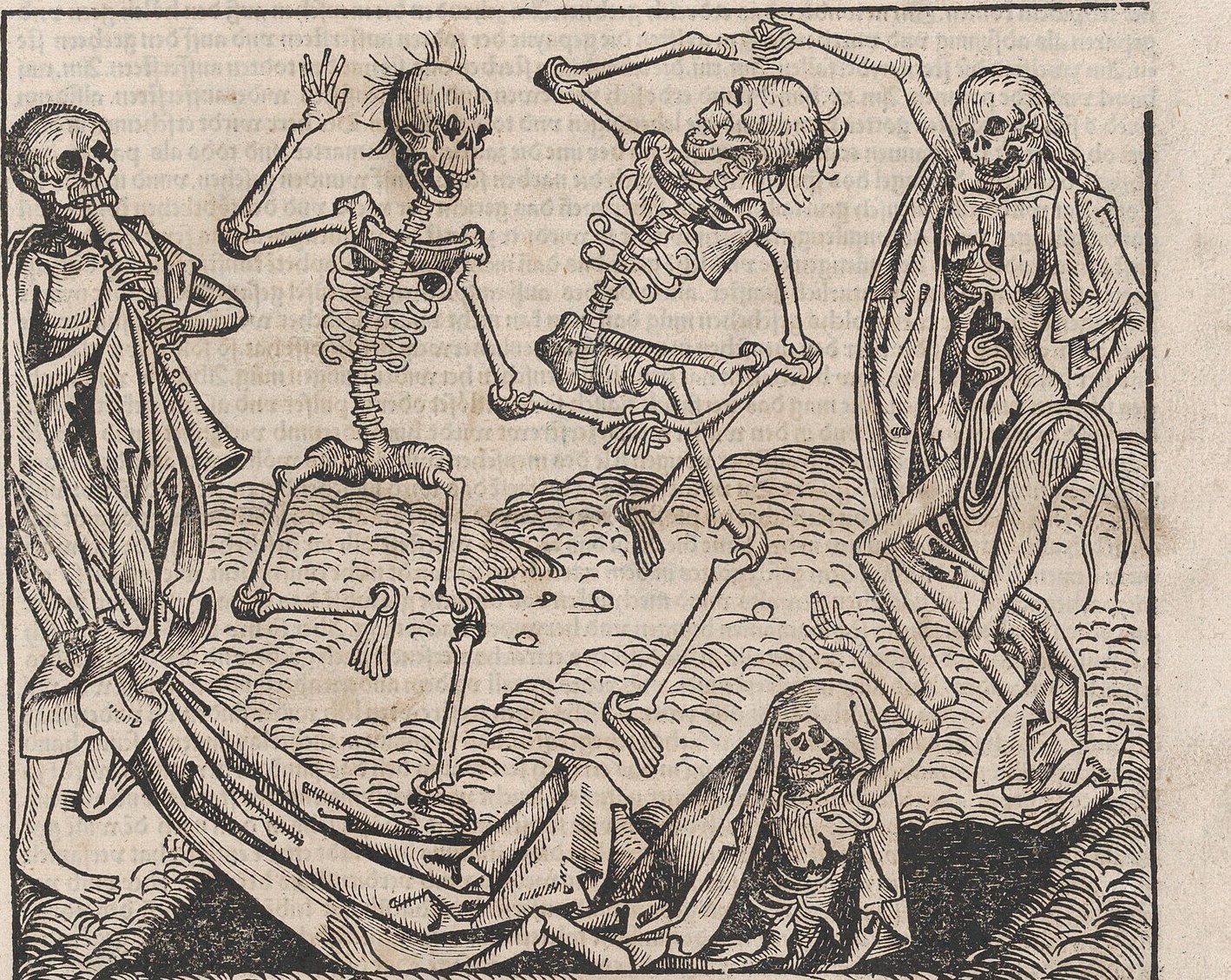
Danse macabre
Midnight. A harp strikes the same note twelve times. Death has arrived in the graveyard, and he's brought his violin.
Saint-Saëns first wrote Danse macabre as a song in 1872, to a poem by Henri Cazalis, and turned it into an orchestral piece in 1874. At the premiere, on 24 January 1875, the audience didn't know what to make of it. It became a hit anyway.
First, Death tunes up, and he tunes wrong on purpose. The solo violinist lowers the top string from E to E-flat, so the two open strings ring out the tritone, the interval once known as diabolus in musica, the devil in music.
Then the skeletons dance. Saint-Saëns brought in a xylophone, back then almost only a folk instrument, so you could hear their bones rattle. Halfway through, the Dies irae comes back one last time, now as a waltz.
Then an oboe crows like a cockerel. Dawn. Everyone back in their graves.
Saint-Saëns wrote it partly under the spell of Liszt's Totentanz, and Liszt returned the compliment by arranging it for piano soon after the premiere.
You've heard it in: the theme tune of the British TV series Jonathan Creek, which is a variation on it.
Listen for: the twelve strokes on the harp, then Death's out-of-tune chord.
🎻 David Garrett recorded it on ICONIC (2022) and took it on the road with the ICONIC tour, Taormina's ancient Greek theatre included, on 18 June 2023, with the Orchestra Teatro di Messina under Gianna Fratta. Night after night on that tour, he shared Cazalis's poem with the audience before Death tuned up. Here it is.
The poem: Henri Cazalis, Égalité, fraternité…
(the text Saint-Saëns set; our translation)
Zig et zig et zig, la mort en cadence
Frappant une tombe avec son talon,
La mort à minuit joue un air de danse,
Zig et zig et zag, sur son violon.
Le vent d'hiver souffle, et la nuit est sombre,
Des gémissements sortent des tilleuls ;
Les squelettes blancs vont à travers l'ombre
Courant et sautant sous leurs grands linceuls.
Zig et zig et zig, chacun se trémousse,
On entend claquer les os des danseurs,
Un couple lascif s'asseoit sur la mousse
Comme pour goûter d'anciennes douceurs.
Zig et zig et zag, la mort continue
De racler sans fin son aigre instrument.
Un voile est tombé ! La danseuse est nue !
Son danseur la serre amoureusement.
La dame est, dit-on, marquise ou baronne,
Et le vert galant un pauvre charron.
Horreur ! et voilà qu'elle s'abandonne
Comme si le rustre était un baron !
Zig et zig et zig, quelle sarabande !
Quels cercles de morts se donnant la main !
Zig et zig et zag, on voit dans la bande
Le roi gambader auprès du vilain !
Mais psit ! tout à coup on quitte la ronde,
On se pousse, on fuit, le coq a chanté…
Oh ! la belle nuit pour le pauvre monde !
Et vive la mort et l'égalité !
Zig and zig and zig, Death in rhythm,
tapping on a tomb with his heel,
Death at midnight plays a dance tune,
zig and zig and zag, on his violin.
The winter wind blows, the night is dark,
moans come from the linden trees;
white skeletons cross the shadows,
running and leaping in their great shrouds.
Zig and zig and zig, everyone wriggles,
you can hear the dancers' bones clacking.
A lustful couple sits down on the moss
as if to taste old pleasures again.
Zig and zig and zag, Death keeps on
scraping endlessly at his sour instrument.
A veil has dropped! The dancer is naked!
Her partner holds her lovingly.
The lady, they say, is a marchioness or a baroness,
and her gallant a poor cartwright.
Horror! And look, she gives herself to him
as if the peasant were a baron!
Zig and zig and zig, what a sarabande!
What circles of the dead holding hands!
Zig and zig and zag, in the crowd you can see
the king capering beside the peasant!
But hush! Suddenly they break the circle,
they push, they flee: the cock has crowed.
Oh, what a fine night for the poor folk!
And long live Death and equality!
• • •
Thirteen pieces, and whenever the Devil or Death needed an instrument, he reached for the one with four strings. He took it from a soldier and from a village fiddler. Tartini handed it to him in a dream. He tuned it wrong in a graveyard, and he kept a rumour alive around Paganini for a lifetime.
We have a theory about why. Nothing else sounds as close to a human voice, and nothing else can scream like one.
Your turn: which of the thirteen scares you most?
Happy Halloween from The Strings Society.
Trick or treat?! 🎃