The First Rock Star
Confession: this one started with Justus. A few weeks ago Justus Eichhorn told us that he had been allowed to play Liszt's own grand piano in Weimar, and that he could feel “his spirit is somehow still there”. We haven't stopped thinking about that sentence since.
So we went looking for the man who owned the piano. We found a rock star. Two hundred years early.
Once, the story goes, a lady-in-waiting bent down and picked a cigar stub out of the gutter.
Franz Liszt had smoked it and tossed it away. She had it set in a locket, with his initials, F.L., picked out in diamonds.
And she wasn't even the most extreme.
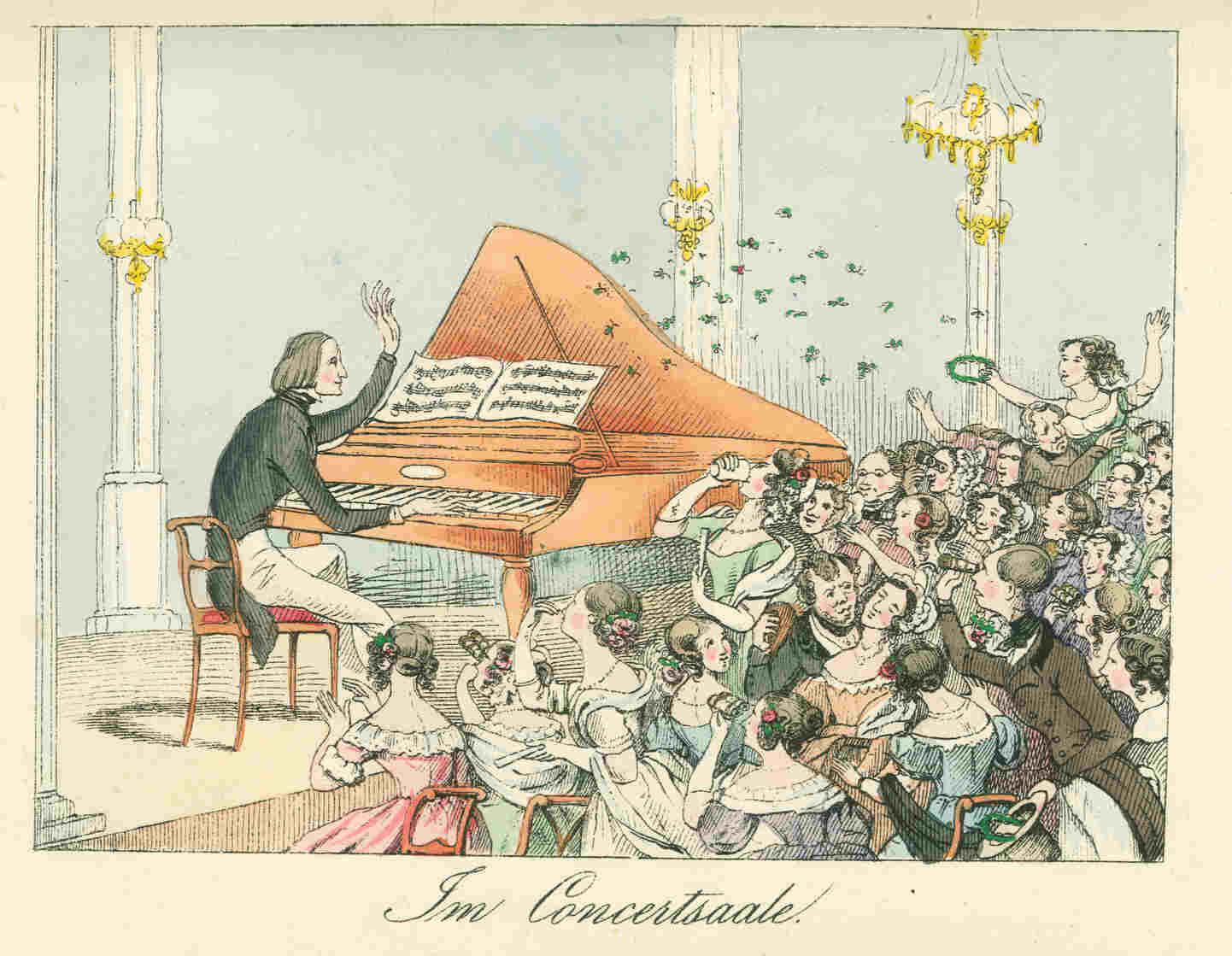
His admirers reportedly fought over his gloves and his handkerchiefs. They begged for locks of his hair. They wore his face on brooches. When a piano string snapped under his hands (and under those hands, strings snapped), somebody would grab it and have it made into a bracelet. A few women are said to have poured the dregs of his coffee into little glass phials, to keep.
Today you'd get a T-shirt. ;)
In Paris, in the spring of 1844, the poet Heinrich Heine sat down to review the concert season and ran out of words. So he made one up: Lisztomanie.
“A veritable insanity,” he wrote, “one unheard of in the annals of furore!”
The word stuck. In 1975 Ken Russell made a film called Lisztomania, with Roger Daltrey, the singer of The Who, as Liszt, and Ringo Starr as the Pope. Rick Wakeman of Yes turned Liszt and Wagner into synthesizer rock. It was a total flop. “He was very much like me,” Daltrey said of Liszt. Watch it at your own risk. ;)
It started in a village on the Hungarian border. He was born on 22 October 1811 in Doborján, today Raiding, in Austria. His father worked for the Esterházy princes and played the cello. Little Franz gave his first public concert at nine. At twelve he was in Paris.
Then, in 1832, he went to hear Niccolò Paganini.
He walked out of that hall wanting one thing: to do on the piano what Paganini was doing on the violin. (Paganini, The Devil's Violinist, gets his own story on 27 October. For his birthday, and just in time for the Halloween mood ;))
He very nearly managed it.
“My travelling circus begins today,” he wrote from Chichester, in England.
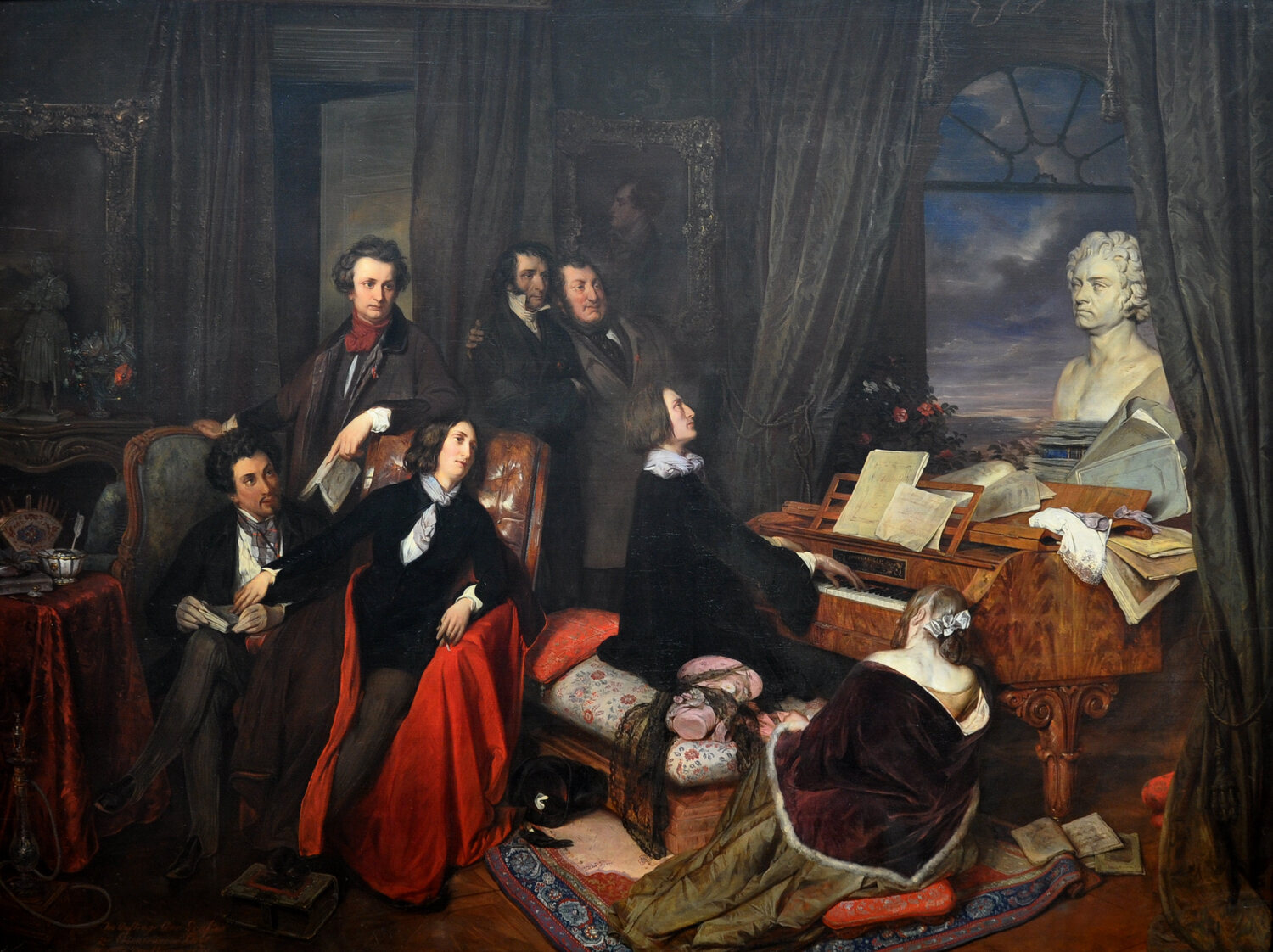
He wasn't exaggerating. On 9 June 1840, at the Hanover Square Rooms in London, the posters promised Liszt's Pianoforte Recitals. It is usually cited as the first time the word recital was used for a concert. One man. One piano. The whole evening, his.
And he staged it. He turned the piano sideways, so the open lid threw the sound out into the hall and the audience got his profile. He played with no music on the stand, which nobody was used to seeing. He talked to the room between pieces. He improvised on the spot. He even had the seating rearranged so he could mingle with the audience.
Over roughly eight years he gave something like a thousand concerts. By coach. Across a whole continent.
Then came Berlin. He arrived around Christmas 1841, and that very night thirty students turned up to serenade him with his own Rheinweinlied. His first concert, at the Sing-Akademie, was on 27 December. From there, the fever spread across Europe.
Not all of the money stayed in his pockets. When the fund for a Beethoven monument in Bonn ran short, he promised, in 1839, to cover the gap himself. In 1842 he played for the people left homeless by the great fire in Hamburg.
In February 1847, on tour in Ukraine, he met Princess Carolyne zu Sayn-Wittgenstein in Kyiv. Within weeks she had resolved to join him in Weimar. She would, the following year.
That September, in Elizabetgrad, he gave what would be the last paid concert of his life as a touring virtuoso.
He was thirty-five. He was probably the most famous musician alive, and he walked away.
This is the part they never put on the posters.
He settled in Weimar in 1848 as court Kapellmeister, and a small town in Thuringia became one of the places in Europe where music happened. He conducted other people's music, generously and often. In 1850 he gave the premiere of Wagner's Lohengrin, while Wagner was a political exile with a warrant out for his arrest and couldn't even be there. Wagner dedicated the opera to him.
At last he had time to write: the symphonic poems, the Faust Symphony, the Sonata in B minor.
And he taught. For the rest of his life, ten or twenty young pianists at a time would crowd into his rooms to play for him. He never took a penny for a lesson.
His house in Weimar still has his furniture in it, and his pianos. Justus played one of them. “I really did have the feeling that his spirit is somehow still there,” he told us.
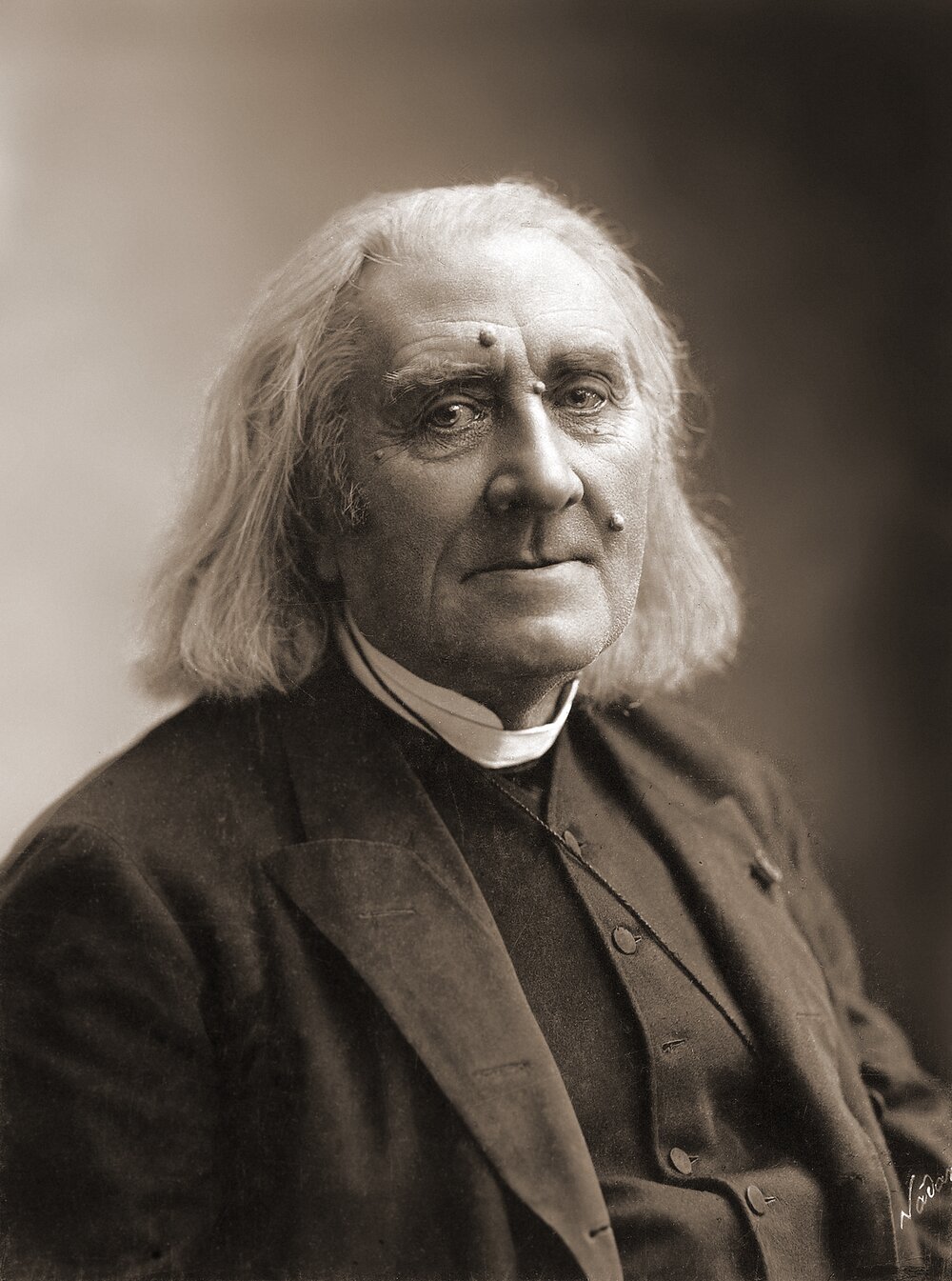
In Rome, on 25 April 1865, he was given the tonsure. On 30 July he received minor orders. The man whose cigar stub had been set in diamonds was now the Abbé Liszt, in a black cassock.
He never really stopped moving, between Rome, Weimar and Budapest, and he never stopped teaching. He died on 31 July 1886 in Bayreuth, during the festival, at seventy-four.
- Liebestraum No. 3. The one you already know, even if you don't know you know it. Try Justus Eichhorn's recording on The Source.
- Hungarian Rhapsody No. 2. If you grew up with cartoons, you already know it. Tom plays it at the piano in The Cat Concerto, which won an Oscar, and Bugs Bunny has a go in Rhapsody Rabbit.
- La Campanella. His piano version of a Paganini tune. One high note keeps ringing like a bell while the right hand leaps all around it. Watch someone play it. Watch the right hand.
- Mephisto Waltz No. 1. The devil turns up at a village dance and takes over the fiddle. Justus plays it on The Source too. Consider it your Halloween warm-up.
- Sonata in B minor. Half an hour, one single movement, no breaks. Written in Weimar, after he had quit touring.
- Nuages gris. Late Liszt: a few strange, grey minutes, written in 1881, when he was nearly seventy. Kubrick used it for the morgue scene in Eyes Wide Shut.
- Consolation No. 3. For when you need the other Liszt: quiet, and in no hurry at all. Justus plays it on The Source as well.
• • •
Happy birthday in advance, Franz. They screamed for you first.